A UTI, fall or a cold can lead to cognitive decline and even death in a person with Alzheimer’s disease

Dementia disease and a loss of brain function and memories

November is Alzheimer’s Awareness Month 

People with Alzheimer’s who get even a mild respiratory or gastrointestinal infection, or a bump or bruise are at risk for having a significant, permanent memory loss, according to a report that was published in the September 8, 2009 issue of the journal Neurology. These patients can have high levels of tumor necrosis factor—alpha (TNF-a)—a protein that is linked to inflammation and is associated with memory loss and cognitive decline.

In the study, which was done at the Clinical Neurosciences Research Division at the University of Southampton, United Kingdom, 222 Alzheimer’s patients were followed for six months. Of those, 110 people had an infection or injury that resulted in inflammation. These individuals had twice the memory loss during that period of time as the individuals who did not have an illness or injury. Researchers attribute the memory loss to inflammation. In patients whose TNF-a levels were high to begin with, an infection increased their memory loss to 10 times more than those who had low TNF-a levels.

Clive Holmes, PhD, lead researcher, said that this population should be vaccinated against the flu, and infections and injuries should be treated as soon as possible.

It is not uncommon for an elderly person to die from a urinary tract infection, especially someone who has dementia. Even a mild cold can develop into a serious pneumonia and lead to death in an elderly person. My husband developed a kidney stone, and died six weeks later. He progressed from a person in mid- to late-stage Alzheimer’s to someone in the final stage of Alzheimer’s, unable to walk or talk.

Tips for keeping you and your loved one healthy and safe

  • Inoculate against flu, pneumonia and shingles
  • Boost immunity with zinc, vitamin D and vitamin C
  • Prevent falls and accidents (recommended: Complete Guide to Alzheimer’s Proofing Your Home by Mark L. Warner
  • Reduce systemic inflammation with a curcumin (turmeric extract) supplement
  • Use a humidifier to moisturize nasal passages and mucous membranes to help keep them healthy
  • Engage in gentle exercise to reduce inflammation
  • Keep hydrated by drinking at least 6-8 glasses of water each day
  • Reduce risk of urinary tract infections with D-Mannose powder and cranberry extract 
  • Use essential oils (lemon, peppermint, lavender, frankincense, bergamot, thyme, sandalwood, vetiver, myrrh) to boost immunity. For more information about the use of aromatherapy to reduce stress, improve immunity, reduce agitation, and to promote relaxation read chapter 18 “Aromatherapy” in “Calmer Waters: The Caregiver’s Journey Through Alzheimer’s & Dementia” by Barbra Cohn
  • Eat yogurt. 70% of your immune system lies in your gut. Probiotics are live bacterial microorganisms that populate the human gastrointestinal tract. They combat the daily bombardment of toxins and pathogens (bacteria, fungus, parasites, and viruses) that enter our digestive system every day through contaminated food and other toxins. Recent studies show that the bacteria in your gut can also affect your mental health, mood and stress levels. Fermented foods such as kombucha, Greek yogurt, kefir, sauerkraut, miso, cottage cheese are probiotics. Probiotic bacteria colonize the digestive tract with good bacteria. Prebiotics are the food and nutrients that feed probiotics. Prebiotic fiber is found in fruits and vegetables such as artichokes, jicama, wild yams, onions and garlic, asparagus, beans, oats, chicory root and Jerusalem artichokes. Prebiotics support mineral absorption, vitamin utilization, and healthy blood sugar levels. Your gut needs both pro- and prebiotics in order to stay healthy and keep you healthy.
  • Drink mineral broth. It helps alkalinize the body and warm the system. It also helps counter the negative effects of stress. Have it as a bowl of soup or sip it throughout the day. Use your vegetables scraps or chop 2 cups yams, 1 medium potato, 1 cup zucchini, 1 cup cabbage, 1 cup green beans, 2 cups celery, 1 cup onions. Add herbs, garlic, parsley–anything you like. Place in a large pot, cover with water, bring to a boil, turn down to a simmer, and cover for 3-5 hours. For more information read chapter  31 “Nutrition” in “Calmer Waters: The Caregiver’s Journey Through Alzheimer’s & Dementia” by Barbra Cohn
BarbraCohn__

16 ways to sleep better . . . so you can be a better caregiver

Woman sleeping on a comfortable bed in the clouds

We’ve all had those sleepless nights in which we toss and turn, look at the clock and feel stressed that we aren’t going to get enough sleep. When you are caring for someone else–whether it’s a toddler, sick relative or someone with Alzheimer’s or dementia, it’s even more important to get a good night’s sleep.

There are plenty of studies linking poor sleep to a host of physical and psychological ailments: poor immunity, elevated levels of cortisol and insulin, weight gain, diabetes, cardiovascular disease and even Alzheimer’s disease. And irritability, foggy thinking and anxiety, depression and low energy can directly impact your ability to care for another person, do household chores and get in the way of your interpersonal relationships.

Here is a list of things to try when you are stressed, your mind is on overload, or when you’ve just had too much stimulation and can’t fall asleep or stay asleep.

Good sleep hygiene is the first step to improving your sleep.

  1. Refrain from drinking caffeine after 1:00 pm.
  2. If you need to visit the bathroom during the night, limit your fluid intake after dinner.
  3. Do not resort to alcohol to help you sleep. It usually impairs sleep, and you might wake up with a headache.
  4. Try valerian, passion-flower or skullcap herbal tea at least a couple of hours before bedtime.
  5. A cup of warm milk with a small pinch of cardamom, coriander, cinnamon, turmeric and cumin, and an 1/8 of a tsp of ghee is a tasty and relaxing bedtime drink. The calcium in the milk is a muscle relaxant and the Indian spices help induce relaxation. Experiment to see which spices you like.
  6. Turn off all electronics at least 30 minutes before bedtime. This is difficult for most people so it will take some effort. Instead, listen to soothing music or read a relaxing book.
  7. Do not watch the news or listen to the radio with current news before bed. World and political events can be upsetting and unsettling.
  8. Make your bed as comfortable as possible. Cotton sheets are usually more comfortable than synthetic. Is it time to replace your mattress? When is the last time you turned it over?
  9. A cool bedroom is usually more conducive to sleep than an overheated room. On the other hand, feeling cold will not help you sleep, either. If you feel cold at bedtime, warm up some neck wraps in the microwave and place them in your bed so it’s toasty when you get in. Then when you feel warm and are starting to fall asleep you can throw them on the floor. Or, warm up your bed with a heating pad. One of my favorite thing to do is to put on pajamas that have been heated in the clothes dryer for 5 minutes.
  10. Get black out curtains. It’s easier to sleep when there is no light coming through the windows.
  11. Eat a banana. Bananas contain potassium and magnesium that help reduce risk of muscle cramps. These two minerals also support heart health and cognitive function.
  12. A drop in blood sugar during the night can cause us to wake up. Although it’s better to not go to sleep on a full stomach, a small protein snack such as a slice of cheese or smear of peanut butter on a cracker can help maintain balanced blood sugar.
  13. Exercise during the day to get your heart pumping and to maintain overall health. Just don’t do it too close to bedtime because you will get energized.
  14. Go to sleep when you get sleepy but make sure it’s before 11:00. According to Ayurveda, the ancient Indian healthcare system, it’s best to be in bed by 10:00.
  15. Melatonin supplements help some people, but you might have to experiment with the dosage. I like Natural Vitality’s Natural Calm, a powdered calcium supplement that you put in water or juice. I also like the homeopathic remedy Hyland’s Calms Forte.
  16. Use ear plugs if it’s noisy in your neighborhood. Again, you might need to experiment in order to find the product you find is most comfortable.

As a caregiver you probably think of yourself last. But it’s crucial that you take care of yourself because if you don’t, it will be able to take care of your loved one(s). So take the time to experiment. Promise yourself that you will put an emphasis on trying to improve your sleep. You will notice a difference right away, and so will everyone in your life.

Good night, sleep tight!


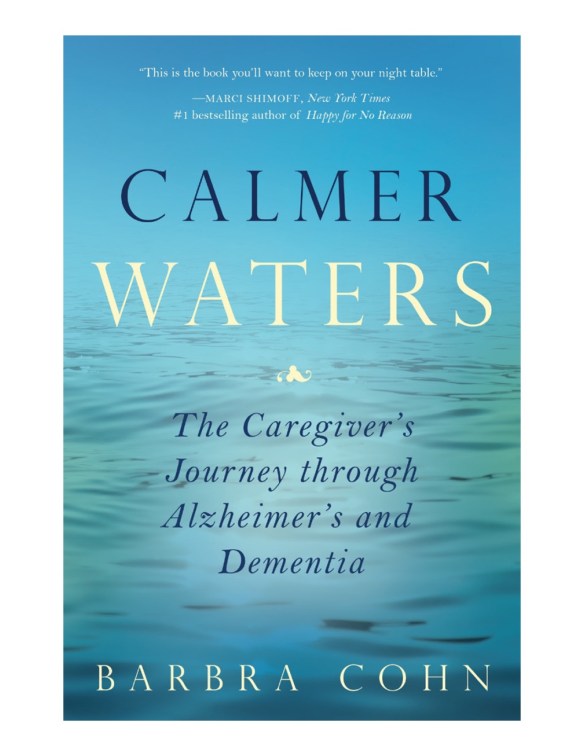
“Calmer Waters: The Caregiver’s Journey Through Alzheimer’s & Dementia” by Barbra Cohn contains a treasure trove of information on how to stay connected with your loved one, keep calm, improve immunity, reduce stress and feel happier and healthier. Plus, it includes 20 healing modalities that the caregiver can do alone or with their loved one. Available wherever fine books are sold and on Amazon.

BarbraCohn__


Dealing with a loved one’s things after their death


Wohnungsauflösung

I confess. I am attached to my material possessions. It’s very important to me that I live in a beautiful environment and that means being surrounded by beautiful things. I have had the good fortune to inherit lovely things from my deceased in-laws. Their various art collections grace my walls and I enjoy them. But actually, at this stage in my life I would prefer to live more simply in a small, uncluttered home where I don’t need an alarm system to provide peace of mind that my beautiful things will be forever guarded and safe.

Now that my mother has passed away I have more beautiful things. But this time around, as I weathered the storms of her many health crises I was able to think about the things I would like to keep and visualize what it would actually be like to clear out her apartment. I contemplated the reality of having to face the thankless task of going through her top drawer and disposing of her most intimate things: eye glasses, hearing aids, medications, bras, and underwear. I think this exercise helped me to get through the actual tasks required after she died.

Creating a safe space for family

I invited my adult children, my brother’s wife and their daughters, my mother’s sister and husband, and a few cousins to my mother’s apartment the day after she was buried. Since everyone lived at least a thousand miles away, the “farewell party” had to be expedient. Most people were flying home that afternoon.

I asked everyone to browse through the things I had laid out on the couch and the many items, including a collection of paper weight and Lladro figurines, that were displayed in two large glass showcases. Next, we took turns choosing what we would like to take home as a remembrance of our mother, sister, grandmother, and cousin. It worked beautifully because my mother’s family happens to be one of the most “normal” families I know. No one fights, everyone gets a long–usually. And that’s how it went without petty arguing or bickering.

But my mother had a will in which she specifically indicated that I, the only daughter, was to inherit her jewelry. A couple of years before she passed, we went through her jewelry together and picked out pieces for her granddaughters and daughter-in-law. And then I found four small pinky size rings with various precious stones that were perfect for her four little great granddaughters. The will made this task easy.

Many years ago, when my mother-in-law died it wasn’t as easy. One family member got greedy which led to some bitter feelings. The key is to make a plan ahead of time. Encourage your loved ones to designate in a will who they want to inherit valuable and sentimental items.

10 tips for making a difficult, emotional process a little easier

  • Consider how much time you have. Do you need to vacate the apartment or house in one week or one year? Personally, I am glad that I had a time limit of one week. Even though the job was exhausting, I’m glad to have it behind me. Dragging it out month after month would seem to me to be even more exhausting, both physically and emotionally.
  • Get help! My aunt, her daughter and my partner, who stayed with me for the entire week, helped tremendously. I could not have done it without them. After everyone pulled out the items they wanted, it was easy for my helpers to go through things and determine if they could be sold or if they should be donated.
  • Find a non-profit agency such as Goodwill to pick up a truckload of furniture. I was shocked when several very nice pieces of furniture were rejected because of a stain or slight crack. These non-profit groups have become very picky, so be sure to ask on the phone if they will accept imperfect furniture pieces. Set a time for pick-up and ask if the items need to be disassembled before pick-up.
  • Bring miscellaneous items such as pots and pans, dishes, books directly to a non-profit organization in order to clear the space for when the bigger items are picked up, if you have the time and energy.
  • Nursing homes and continuum care facilities sometimes have a “store” on the premises that accepts used items. They often are eager to accept artwork and medical supplies such as wheel chairs, walkers, commodes, etc. If not, give these to someone in need. You might even find a neighbor on the same floor as where your loved one lived.
  • Take photos of photos to save money and space. My parents kept dozens of photo albums from their many trips. I shipped home some albums that included family life cycle events and gatherings. My brother, however, wanted all the travel albums. Instead of spending a fortune on shipping heavy albums, I removed the photos and put them in shoe boxes. My daughter took photos of the special family photos to archive.
  • Keep important papers: insurance policies, birth certificates, car titles, etc.
  • Don’t stop and read every letter or card that you ever sent your loved one. Box them up and bring them home to read when you aren’t as emotional.
  • Do not flush medications down the toilet! They get into the water supply. Boulder County’s website says: Pour liquid medications over cat litter or other absorbent material, and seal it in a plastic bag before placing it in the trash. Fill pill containers with household glue, remove all personal information from the container, and place it in the trash after the glue has dried. Cut trans-dermal patches into small strips, place them in a container, and add glue or mix them with coffee grounds or used cat litter. In some areas, you can bring medications to the fire or police station.
  • Don’t feel guilty about getting rid of stuff. The objects meant a lot to your loved one. But your memories are not contained in the favorite necklace your dad gave to your mom. Your dad’s favorite golf clubs that he won several trophies with don’t hold the same meaning for you. Your spouse’s slippers are old and ratty and it’s time to get rid of them. As we reminisce and go through our loved one’s material possessions, it is a good time to start downsizing our household and to think about our own mortality and how we want to live the rest of our life. The memories of celebrating your loved one’s life will always be held close to your heart. As you go through their items, remember the saying “You can’t take it with you.” It might just help, at least a little.

“Calmer Waters: The Caregiver’s Journey Through Alzheimer’s & Dementia” by Barbra Cohn contains a treasure trove of information on how to stay connected with your loved one, keep calm, improve immunity, reduce stress and feel happier and healthier. Plus, it includes 20 healing modalities that the caregiver can do alone or with their loved one. Available wherever fine books are sold and on AmazonBarbraCohn__

Need something to help your loved one find a purpose? How one caregiver discovered that art therapy can be rewarding and stress reducing for herself and her mom.

I’d like to introduce guest blogger Heather O’Neil of Yorkshire, United Kingdom. She graduated in 1984 with a degree in Art & Textile design and writes a blog on how art therapy can help those living with Alzheimers.  Creative Carer

Read how she has used her skills to engage her dear mother in productive and satisfying art projects. Heather and her mum are amazing!

Find more information about art therapy, including simple art projects that both caregivers and loved ones with dementia can enjoy, in chapter 19 of my book “Calmer Waters: The Caregiver’s Journey Through Alzheimer’s & Dementia.” Available wherever fine books are sold. BarbraCohn__


By Heather O’Neil

My mum was diagnosed with mixed dementia – Alzheimer’s & Vascular Dementia – in 2012 when she was 82. Since then I have constantly researched how best to cope with the disease and have looked for different ways to stimulate her memory and keep her active, happy and engaged despite her Dementia.

Studies show that Art Therapy stimulates the brain, reduces agitation and creates a sense of accomplishment and purpose. This has been the perfect therapy for my mum as she has always been a very creative person.

She passed on her love of arts & crafts to me and I graduated in 1984 with a degree in Art & Textile design. I have been able to introduce my inherited creativity into my caring and I was called the ‘Creative Carer’ by mum’s memory clinic!

I started our Creative Carer Face Book page a couple of years ago to share our activities & ideas. We now have followers from all over the world and have made some wonderful friends.

www.facebook.com/CreativeCarer

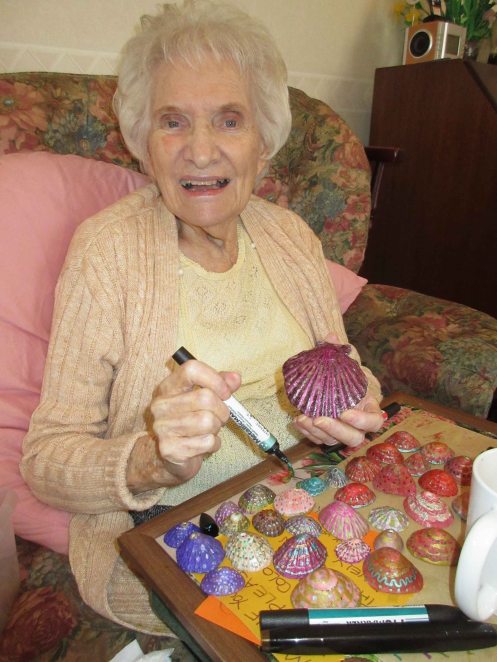
I spend time every morning with my mum and make sure she always engages in some form of artistic activity … from colouring to card making … shell craft to painting stones!

3a

IMG_4021.JPG

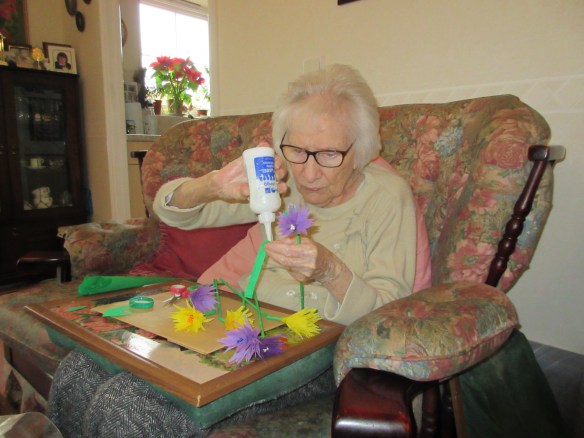
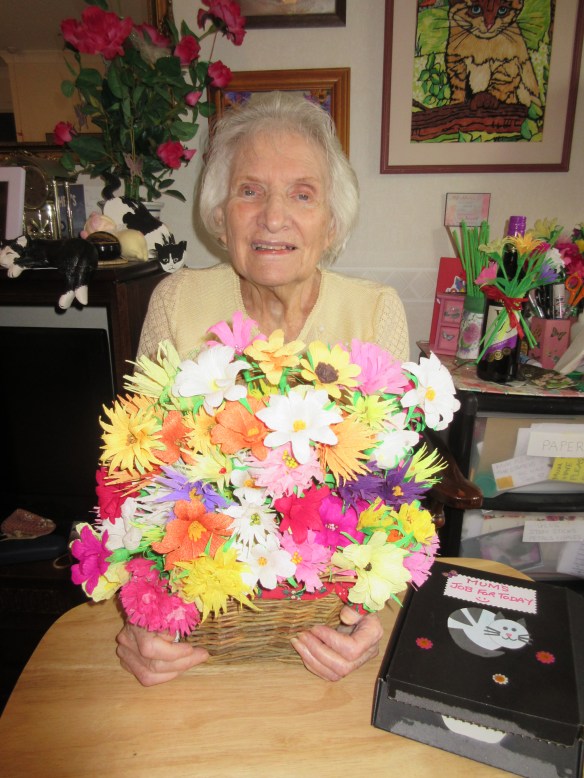
My mum’s favourite hobby is making beautiful crepe paper flowers. This is a craft she enjoyed when she was much younger … I remember wonderful displays in our home when I was growing up so it has been lovely for her to be able to enjoy her flower making once again!

Due to the Alzheimer’s my mum has lost a lot of confidence and she can no longer design and cut out shapes freehand. However, if I supply a cardboard template she is happy to follow the pattern and will sit for hours cutting out pretty petals and leaves. She particularly enjoys covering wooden kebab skewers with long strips of green crepe paper to create the stems! Making the stems is an activity she can do all on her own and she can cover a pack of 100 skewers in an afternoon 😊

Together we glue the stamens and petals to the stems and once she’s done two or three with me, she’s usually able to carry on by herself! Beautiful crepe paper flowers fill the house and are a constant reminder to her that she is wonderfully creative!

IMG_2506
IMG_3649

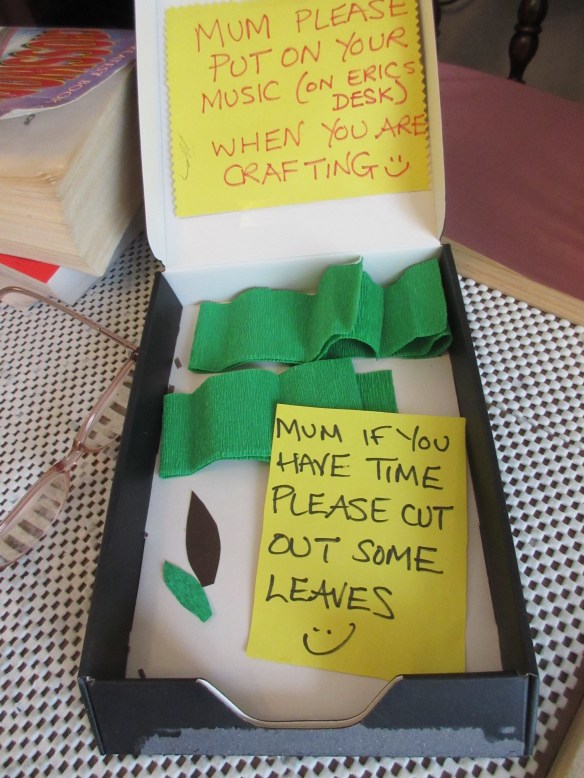
I had the idea to introduce a “Job Box” a few months ago with amazing success! My mum loves to be busy during the day but without me there to encourage and suggest activities she struggled to start any projects. The “Job Box” gives her a reminder of what she can do in the afternoon when I’m not with her. Every day I will leave her a “job” … cutting out petals for example … when I return the next morning the box will be full of her work and she’s always so proud to show me what she’s accomplished.


IMG_4475

IMG_4521

Mum’s flowers have been greatly admired on our Face Book page and my blog and we have been asked many times if she sells them. With so much stock around thanks to the “Job Box”, I decided to fulfil her ambition of having her own little business!! On the 29th of August 2017 I opened an Etsy shop for her! We pledge to give 25% to the Alzheimer’s Society and already have made over £110 for them!! Mum’s flowers have been shipped all round the world … from the UK to America, Canada and Australia!!! Absolute proof that you are never too old to fulfil your dreams and with a little support and creative encouragement there really can be a future after an Alzheimer’s diagnosis.

3 (2)

1


www.creative-carer.com

http://creative-carer.blogspot.co.uk/2016/06/making-paper-flowers-art-therapy-for.html


10 Things to Remember if You Love a Person with Dementia

Assisting and helping elderly peopleToday is World Alzheimer’s Awareness Day. It’s a good day to repost this important article and to remind people about the book I wrote after caring for my husband who passsed away from younger-onset Alzheimer’s disease seven years ago. The book has helped so many people, which is what my intention was in writing it. “Calmer Waters: The Caregiver’s Journey Through Alzheimer’s & Dementia” contains a treasure trove of information on how to stay connected with your loved one, keep calm, improve immunity, reduce stress and feel happier and healthier. Plus, it includes 20 healing modalities that the caregiver can do alone or with their loved one. Available wherever fine books are sold and on Amazon.

It’s sometimes hard to love a family member who has dementia or Alzheimer’s disease. People with dementia can be quarrelsome, uncooperative, negative, whiney, belligerent or combative. They might get their nights and days mixed up, pace the floor for hours, wring their hands non-stop, or cry like a baby. They might ask you the same question twenty times in a row, refuse to budge when you need to get them to an appointment, or refuse to eat what you’ve made for dinner.

When the going gets tough, it helps to remember that you love the person who resides inside that body that is tight and tense and inflamed from amyloid plaque that has strangled the neurons and disrupted the neurotransmitters that allow thoughts to flow and emotions to stay even. He or she is the same person you married, the same loving parent who nurtured and guided you, the same sibling you shared holidays and outings with, or the same friend who offered a should to cry on or who helping you move to a new home.

When you’re about to lose it, walk out, or hide in the closet, stop for a moment and remember at least one of these 10 things about the person you lovingly take care of.

People with dementia and Alzheimer’s often feel:

  1. Embarrassed when you say, “ I just told you . . ..” Instead of reminding them that they forgot what you told them a second ago rephrase it, breaking it down into a simple sentence . . . or completely change the subject.
  2. Fearful because they don’t see things spatially the same way we do. Their sense of space is distorted and their vision gets skewed, not because there is something physically wrong with their eyes. But rather, the brain interprets what the eyes see, and when the brain doesn’t work right our perception gets distorted. Two things you can do to help are to put extra lights in dark areas of the living quarters and remove throw rugs in order to reduce falls.
  3. Lonely because they can’t communicate well, or some of their friends have “jumped ship.” Set up times for family or friends to visit or take your loved one on an outing.
  4. Confused because they don’t understand why they can’t drive anymore, or why they can’t go for a walk alone, or why they can’t remember where they live or what their son’s or daughter’s name is.
  5. Angry because the keys to the car have been taken away, or because they get frustrated when they can’t express their feelings or thoughts.
  6. Sad because they can’t read a book or newspaper, or can’t manage to engage in their favorite hobby or sport.
  7. Anxious because they can’t move as fast or get dressed by themselves or put on their shoes easily. Or, because they hear sounds that are disturbing or are bothered by someone else’s behavior.
  8. Nervous because they have lost their sense of balance and feel unsteady on their feet. Or because they don’t like the feel of water on their skin and don’t want to bathe and don’t want to be forced.
  9. Frustrated because they can’t write a check, figure out how much tip to leave, or remember how to use the TV remote control.
  10. Paranoid because they think someone is stealing their money or prized possessions.

When all else fails, take a deep breath and put on some music. It almost always uplifts the spirit—for both the caregiver and the person being cared for.

Please subscribe to my blog for more informative articles like this. Thank you!

12 ways to make sure your loved one is safe in a nursing home


Nurse serving food in nursing homeIt’s horrific and tragic that eight residents of a nursing home in Hollywood, Florida died this week as a result of dehydration, respiratory distress, and heat-related issues.  The nursing home administrator Jorge Carballo said “The Center and its medical and administrative staff diligently prepared for the impact of Hurricane Irma. We took part in emergency management preparedness calls with local and state emergency officials, other nursing homes and health regulators. In compliance with state regulations, the Center did have a generator on standby in the event it would be needed to power life safety systems. The Center also had seven days of food, water, ice and other supplies, including gas for the generator.”

But clearly something was wrong, very wrong. One man who learned about his mother’s death from a report said communication with the staff had always been difficult, so it did not strike him as unusual that his calls were not returned. Lack of communication is a big red flag.

My husband spent a little over two years in an assisted care facility, and my mother lived in a continuum care facility for seven years. Here is what I learned from my experience as the primary family caregiver responsible for making decisions about their care.

  1. If you anticipate that your loved one will be going into a nursing home or assisted living facility in the near future prepare months in advance. Visit a number of facilities in the area where s/he will live. Once you shorten the list to two or three, drop in unannounced so you can observe how the patients are treated. Supposedly, the best time to “drop in” is Saturday evening when there are fewer staff members around and visitors are not expected. Your senior services ombudsman will know which facilities have had complaints filed against them and can give you an idea of which ones to look at based on your family’s needs.
  2. Notice if residents are crying out for help, are in distress or appear dehydrated, and if their needs are attended to quickly. Be aware of odors (especially ammonia or urine) and whether the halls, dining areas, and residents’ rooms are clean.
  3. Once your loved one makes the transition into a home, get to know the staff—as intimately as your time allows. By making a personal connection with the people who care for your loved one, you will become more than a familiar face.  Professional caregivers make little income, have a huge responsibility, and are often the people who know best about the patient’s needs and status. These are people with families of their own. Ask about their child’s sports team or dance class. Ask about their grandchild’s birthday, etc. Your personal interest in their life will be appreciated and they will naturally develop an interest in your loved one and your family.
  4. A friend of mine visits his wife in a nursing home every single day, bringing her fresh berries or cut-up melon because the home doesn’t provide fresh fruit. It’s not practical for everyone to visit a loved one every day, but when you do, bring something nutritious such as fresh fruit instead of sweets. Fresh fruit is usually easy to eat and provides vitamins and antioxidants that help prevent colds and flues.
  5. Make sure water is provided throughout the day–not just that it is available but that it is offered. Seniors often lose the signal that they are thirsty and dehydration can be a serious problem for the frail and elderly.
  6. If your loved one is incontinent, make sure there are plenty of adult diapers in the room and that s/he is being changed regularly. Urinary tract infections are a serious problem with this population and staying dry and clean is a key to preventing them!
  7. Be on the alert for bruises or sores. A bed sore can lead to a systemic infection and death. Speak to the attending doctor or nurse immediately if you notice a sore that is not healing. A bruise can indicate that your loved one has fallen or, in the unlikely but not unheard event, that s/he has been abused.
  8. Sit with your loved one while s/he eats in the dining room. Is she able to feed herself or does she sit there not knowing what to do with her sandwich? If it is a problem, make arrangements with one of the staff to help her.
  9. Does your loved one require oxygen? Nursing homes are required to have generators in case of power outages such as during a hurricane. Familiarize yourself with the provider of the oxygen that your loved one receives and make sure the company is equipped to provide liquid oxygen for use when there is no power.
  10. Remove all loose rugs and obstacles in the room that your loved one might trip on. Also, place a lamp in easy reach of the bed so s/he doesn’t fall while trying to turn it off or on.
  11. My husband lost numerous pairs of glasses when he was in the assisted living home. Leave at least one extra pair with the floor nurse, and keep an extra pair at home.
  12. Know who to talk to if you have a question or concern. Over the years, I had to speak with the director of the facility where my mother lived several times. Don’t be shy and don’t be afraid of making a nuisance of yourself. Your family might be paying big bucks for the care you expect. If something is not agreeable to your loved one or your family speak up. Most of the time the director will be appreciative to hear your concerns and the matter will be quickly remedied. If not, contact the regulatory agency in your state to file a complaint. On this page you’ll find contact information for each state and territory. We provide information (where available) so that you can: 1) file a complaint about a nursing home; and 2) find additional nursing home information provided by a state.

12 ways to ensure end of life peace for our loved ones and ourselves

White Bird in Clouds

A couple of years ago, Mom and I talked about facing the end of her life. I asked her if she had a good life and she said, “yes.” I asked her if she had regrets and she said, “yes.” But she didn’t want to talk about that. I told her I would do my best to be with her at the time of her passing. I was, and I am thankful that I fulfilled my mother’s wish and my promise to her.

Just two weeks ago my beloved mother passed away from pneumonia. Pneumonia has traditionally been called “the old man’s friend” because a frail elderly person typically loses consciousness and passes fairly easily in sleep. Although it was not easy watching my mother drown in her own fluid, she appeared to not be in pain. Her breathing was labored for hours, and then she sank into a state of peaceful acceptance as her last breaths came in whispers until the last tiniest breath sealed the finality of her life. 

I’m relieved that I had made the funeral arrangements with my brother a year ago. At least I didn’t have to deal with that on the day that the earth stopped spinning and I forgot to drink water as I faced a new reality of living in a world without a mother. I am also relieved that I made arrangements with Chevre Kadisha, the Jewish Sacred Burial Society. Many religions have complex codes of conduct for survivors and very specific rituals and customs that have been carried out for centuries. Harvey Lutske writes in The Book of Jewish Customs that the practices and customs rabbis established for survivors to observe following the death of a loved one help the survivors “cope with their loss, continue with their lives, recover emotionally, pay respect to the dead, and perpetuate the memories of those who have gone before us.”

Final gift of love

My mother’s body was lovingly washed by a group of women in a ritual called Taharah. This cleansing requires several people because the entire body must be washed and moved from side to side in a specific way according to Jewish law. Afterwards, a huge amount of water is poured over the body and passages are read from the Song of Songs. The people performing the Taharah ask for forgiveness in case they performed some indignity. The body is then dressed in a cotton or linen shroud and put into an unadorned, pine coffin. Typically, someone sits with the body or “met” until internment. This is called sitting Shimira, and it is often done in two-hour shifts around the clock. The person reads psalms or prayers silently or out loud, or meditates while a candle burns continuously at the head of the coffin.

Buddhists also incorporate a cleansing of the body and a vigil into their mourning ritual. Families are often invited to wash the body of their deceased loved one. Washing a corpse enables you to become intimate with death in a way no other thing does. It’s hard work, but it’s an important way to honor the dead, said one Buddhist minister.

Death is the great equalizer

To the question, “What is the value of death?” the Jewish rabbis answered, “If nothing ever died, we, the human race, would not learn how to value time. Life’s finiteness is earmarked, and ended, by death. And learning to face death may be life’s greatest challenge.”

As hard as it is, we can take control and manage the death and dying of our loved ones. We can do things that make sense to us and provide us with comfort. Kim Mooney, the Board President of Conversations on Death, and Director of Community Education for Tru Community Care, Colorado’s first hospice, says, “The more you’re involved in the death and grieving process, the more we’re able to be in touch with that innate place in ourselves that tells us how to live. It’s the fear of death that makes us live. And it’s the terror of death that makes us run from the experiences that will teach us.”

As painful as it is,’ says Mooney, grief work and dealing with the death of a loved one guides how you’re going to live your own life. “We’ve skewed our relationship to death in this society,” she says, “but we can’t walk away from it. If you don’t do the work around it, you will somehow diminish the quality of your life. Grieving is a life-long process. Our lives are a series of gains and losses. Learning how to grieve, and incorporating a loss and moving on is critical to being able to become a mature, spiritual person because it implies an acceptance of what life is.”

I am an expert at grieving because of my significant losses. But this time will be different because I lost my mother, my primary connection to the world. This time is especially profound because no one can replace a mother. It will take time before I don’t have the thought to call her, to check in with her, to make sure she is okay. And even though I have children and grandchildren, I will always ponder the profoundly unique love that binds a mother and child in remembering my own sacred relationship with my mother.

In listening to the sweet words and stories that so many people told me after learning of my mother’s passing, I am reminded that it is how we make people feel—not what we accomplished—that is what we remember about a person. Death once again serves as a teacher to remind me that we are here temporarily, and that as my teacher loved to say, “Do not trust the time. Life is short, make it sweet.”

These personalized rituals can provide comfort and ease the intense pain that accompanies death, dying and grieving:

  1. Have a heart-to-heart talk with your loved ones before they get too ill. The Five Wishes is an easy-to-read end-of-life document that helps makes the difficult discussion about what you would like your end of life to look like.
  2. Hospice is a free palliative service offered by Medicare/Medicaid that supports the dying patient as well as the family
  3. Play music that the dying person loves, sing hymns, chant, etc.
  4. Dress and wash the deceased and dress the body in a white linen shroud
  5. Muslims typically share their prayers with the person who is dying before encouraging the dying person, if possible, to say or listen to the words, “I bear witness that (there is) no god except Allah; One is He, no partner hath He, and I bear witness that Muhammad is His Servant and Messenger. Once the person has passed away, the next step is to perform the ghusl, (similar to the Jewish taharah) or the washing of the deceased’s person body. The ghusl can can be done by most adult family members of the same sex as the deceased. After the body is washed, it is then enshrouded, typically in plain, white cloth.
  6. Have a meaningful farewell service
  7. Honor the loved one at different times during the year
  8. Build memory books
  9. Finish what the deceased person didn’t
  10. Write letters to the deceased and writing them back to yourself
  11. Donate a toy for the age of a baby or child who died to “Toys for Tots
  12. Write a life story


Lonely? Two easy ways to make meaningful connections that might just help you live longer.

Bringing Back MemoriesBarbraCohn__

“Calmer Waters” contains more great information on how to stay connected, improve your immunity, and reduce stress. Available wherever fine books are sold and on Amazon.

I’m no stranger to loneliness. When I moved cross-country as a college student to a place  that was as foreign to me as if I had time-traveled to a different century, I didn’t know a soul. It didn’t help that I had transferred my second semester sophomore year after everyone had established their group of friends. I’ll never forget the feeling of being alone in the world, not having a friend to confide in or hang out with. Having moved from my hometown where I grew up surrounded by many relatives and a strong support network, I felt like an alien who didn’t know which foods would sustain or poison me. That experience has allowed me to understand what loneliness is and how it can trigger a downward spiral to depression. Now we are hearing from the medical community how devastating this “aloneness” can be.

Studies are showing that loneliness might be a bigger health risk than smoking or obesity. In fact, loneliness and social isolation is considered not just a psychological issue but a medical one that can actually kill you. According to a far-reaching study (meta-analysis of scientific literature on the subject January 1980 to February 2014) conducted by Brigham Young University, social isolation and loneliness is as dangerous to health as smoking 15 cigarettes and drinking six ounces of alcohol a day, and increases one’s likelihood of death by 32%.

Isolation and feeling alone has also been shown to contribute to depression, cognitive decline, the risk of developing Alzheimer’s disease, and poor recovery from illness and surgery.

Two programs that help seniors and caregivers connect on a personal level

Senior Center Without Walls

Senior Center Without Walls is a telephone-based national program that offers free weekly activities, education, friendly conversation, classes, support groups, and presentations  to individuals 60 years or older anywhere in the United States. There are activities occurring throughout the day, every day.

Play a game, write a poem, go on a virtual tour, meditate, share a gratitude, get support, and most importantly, connect and engage with others every day. SCWW is a community consisting of participants, staff, facilitators, presenters, and other volunteers who care about each other and who value being connected. All groups are accessible by phone and many are acessible online.

Katie Wade, program manager, says SCWW offers 75 options. People can join a particular group, call in the same time each week, hear the same voices on a regular basis and make friends. This has a positive impact on their emotional and physical life. “The gratitude activity, which is offered twice a day, is especially popular and well attended,” says Wade. “Participants share something they are grateful for. This allows for an increase in social connectedness. We also have fun and intellectual programs that help individuals feel valued, stimulated and engaged, and sometimes we invite presenters from the outside in.”

Wade points out that Senior Center Without Walls is not just for people with mobility concerns. We get folks who are active, people who are married and individuals in a co-housing situation. Anyone can feel lonely, she says. “We take a survey every year and the results indicate that 85% of our participants feel more intellectually stimulated and  socially connected. And on a daily basis, we get calls of gratitude from participants who say, ‘this program saved my live,'” says Wade.

Senior Center Without Walls is an award-winning program of Episcopal Senior Communities. For more information: SCWW@jtm-esc.org 1-877-797-7299 (also known as 1-877-797-SCWW)

Circle Talk

CircleTalk is a structured conversation program guided by leaders trained to inspire sharing among the participants. It follows a customized curriculum that engages older adults in meaningful conversations through creative activities. Director Deborah Skovron explains that the program is modeled on Rachael Kessler’s Passage Works Institute which works with school districts throughout the United States to teach teacher how to create safe, positive environments in which students are free to experience deep connection to themselves, others, and the world around them.

“Rachael asked me to take the principles of her model and create a program for seniors,” explains Skovron. Now, after eight years of development and refinement, Circle Talk has six programs running at any given time in senior living communities in Boulder, Colorado. A trained leader guides the one-hour circle following the same six steps, says Skovran.

  1. 10-12 people sit in a circle and get name tags.
  2. The group settles down by being led in a brief meditation.
  3. The leader does a warm-up activity asking simple questions such as, “What was your favorite game as a kid?”
  4. Next, the leader connects to the previous week by saying, “Last week we talked about . . .”
  5. The main focus of the week is introduced. A topic might be something like “What’s an important moment in history that helped inform who you are today? i.e. the first man on the moon, the Depression. How did it impact your life?” This leads to questions and conversation.
  6. The leader ends with a ritual such as asking each person to pass a message to the person sitting next to him/her, passing a squeeze, giving a “word” for the week, etc.

“My favorite thing is finding out no matter what age people are, they still require connections to other people and to themselves to remember who they have been. Circle Talk really allows for that opportunity,” says Skovron.

Skovron’s goal is to make Circle Talk available nation-wide. For information about volunteering, becoming a certified leader, donating, or participating in Circle Talk, visit CircleTalk. Circle Talk programs are thoughtfully designed conversation groups. They make it possible to form new relationships, providing a chance for reflection and self expression that many thought were lost to them forever.

10 Summertime eating tips to help caregivers keep their cool

Concept of healthy vegan dessert

It’s summertime and the livin’ is easy—or at least we’d like it to be. If you’re tired and stressed out from caregiving, here are some tips to help you stay cooler in summer.

According to the ancient Indian system of Ayurveda our body consists of three main elements or doshas—Vatta, Pitta and Kapha. Pitta consists of water and fire. It’s hot, so during summer when the temperature rises we want to eat cooling foods. Eating cooling foods not only keeps us from overheating, it reduces the tendency to get irritable, impatient and angry.  (Chapters 20 and 31 in “Calmer Waters: The Caregiver’s Journey through Alzheimer’s and Dementia” contain more information about ayurveda and nutrition that calms down the nervous system and supports immunity.)

COVER.indd


1) First and foremost, stay hydrated. It’s especially important to make sure you and your loved ones are getting enough liquids because when we forget to drink we can become dehydrated quickly, which leads to other health problems. It’s also crucial to keep the brain hydrated in order to maintain mental alertness. Drink plenty of water and stay away from carbonated and caffeinated drinks. Herbal teas, and fresh fruit or vegetable juices are great in summer. Just remember that fruit juices are high in sugar and calories.

  • 2) Enjoy the bounty of summer fruits and vegetables. The summer fruits such as peaches, apricots, cherries, watermelon, cantaloupe, and berries are especially good for helping the body reduce the fiery heat of summer. According to Ayurveda, some of the recommended summer vegetables include cucumber, green leafy vegetables, green beans, squash, zucchini, asparagus, beets and eggplant.
  • 3) Sprinkle on the herbs and spices. They’re easy to use and contribute added flavor and antioxidants to your diet. Cooling spices include cardamom, coriander, fennel and tumeric. Cooling herbs include cilantro, mint and dill.
  • 4) Avoid hot, sour and salty foods including fermented food, red meat, and greasy and spicy food. Excess pitta aggravates the tendency towards heartburn and gastric hyperacidity.
  • 5) Here’s some good news—Ayurveda recommends ice cream during the hot summer months! So by all means, enjoy! Dementia patients are especially fond of ice cream. If the person you are caring for refuses to eat or eats very little, try serving ice cream. It contains protein, calcium and calories, and it’s easy to serve and eat. If weight gain or cholesterol is a concern, select a dairy-free version of America’s favorite dessert. Rice Cream, Coconut Bliss and Soy Delicious make delicious non-dairy, frozen desserts.
  • 6) Cooling grains include amaranth, barley, quinoa, rice, tapioca and wheat. Use them in salads mixed with veggies. One of my favorites is quinoa salad. Cook 1 cup of quinoa. (Be sure to rinse it first to remove saponin, a naturally occurring chemical that coats each grain to ward off insects. It has a strong, bitter flavor. And yes, it is a pain to rinse quinoa. First soak it and then place it in a very fine mesh strainer and rinse.)  Sauté onion and zucchini, add a handful of fresh corn cut off the cob, mix with the quinoa. Add fresh tomatoes, black beans, and a dressing made with olive oil and balsamic vinegar. Delicious!
  • 7) Make your own granola. Once you do, you’ll never go back to buying store-bought granola, which is typically filled with sugar. Plus, it is expensive. Oats, almonds, and coconut are all cooling. First toast 1/2 cup of slivered almonds on a cookie sheet in the oven. Watch carefully so they don’t burn. Add to 4 cups of oats, along with 1/2 cup coconut flakes, 1/4 cup coconut oil, 1/4 cup maple syrup. Add 1/2 tsp of cinnamon, if desired. (Cinnamon is warming, but a little bit won’t hurt.) Stir and bake at 325 degrees for about 20 minutes. Add raisins if desired.
  • 8) For added protein, top your salads with these cooling legumes: garbanzo, pinto, white beans, azuki beans, and black-eyed peas.
  • 9) If you eat meat try to avoid beef, chicken, and pork during the hot months and use cooling meats such as buffalo, turkey rabbit or venison instead.
  • 10) My roses are bursting with fragrance and beauty. Roses are especially cooling and ff you have rose bushes that are free of chemicals, here’s a special treat to make: Rose Petal Jam. It’s fun and easy and the person you are caring for might even like to get into the act. It’s also very cooling and pacifies irritability. Spread it on toast, put a teaspoon on top of a scoop of ice or add it to warm milk for a yummy nightcap. (see recipe below) You can also make a rose petal lassi using a tablespoon of rose petal jam. Or use the delicious recipe below to make the classic, cooling Indian-style milkshake.

Rose Petal Jam

Ingredients

  • ◦ 1 cup fresh rose petals (must never have been sprayed with any chemicals)
  • ◦ 3/4 cup water
  • ◦ 1 lemon, juice of (1/4 cup)
  • ◦ 2 1/2 cups sugar or evaporated cane juice crystals
  • ◦ 1 package pectin
  • ◦ 3/4 cup water

Directions

  1. Puree rose petals, 3/4 cup water and lemon juice in blender until smooth.
  2. Slowly add sugar.
  3. Blend till all sugar has dissolved; (leave in blender) Stir 1 package pectin into 3/4 cup water, bring to a boil, and boil hard for 1 minute. Pour mixture into blender with rose petal mixture until well blended.
  4. Do this very quickly – it sets up FAST!! Pour into small, sterilized jelly jars.
  5. Let set for 6 hours, till firm.
  6. Will keep one month in refrigerator.
  7. Freezes well.

Rose Water Lassi

  • 2 1⁄2 cups plain yogurt
  • 1/2-teaspoon fine sugar
  • ¼ tsp of ground cardamom
  • 2 teaspoons pure rosewater
  • 3⁄4 cups Ice water
  • 1 cup Ice cube cracked
  • Fragrant rose petals for garnish

Blend the yogurt, sugar, cardamom, rose water and iced water in a blender for 2 minutes. Add the ice and process for another 2 minutes. Pour the lassi into tall, refrigerated glasses and garnish with rose petals. Chill out and enjoy!

10 Ways caregivers can reduce stress and feel instant relief

Spa still-life.

June is Alzheimer’s & Brain Awareness Month, and in celebration of the anniversary of the release of my book “Calmer Waters: The Caregiver’s Journey Through Alzheimer’s & Dementia” this month I will be posting ways that caregivers can relieve stress, feel better and more energetic, and forge a stronger connection to the person they lovingly care for.

  1. Before you get out of bed in the morning, breathe deeply and for a minute or two repeat an affirmation such as: “Today will be a good day.” “I am a loving, patient person.” “I’m feeling strong and healthy today.” “I am grateful for my family and friends.” “I am a kind, compassionate caregiver.”
  2. Eat a good breakfast. Your blood sugar is low when you awake after fasting for 6-8 hours. Support healthy blood glucose levels by eating protein, a complex carbohydrate, and colorful fruits or veggies for vitamins and antioxidants. A bowl of cereal with low or no-fat milk doesn’t cut it. As a caregiver you need the energy to get you through the morning. My favorite energy-boosting, neurotransmitter supporting breakfast is eggs (anyway you like them), sautéed kale or spinach with onions, a side of beans and melon or strawberries to finish it off. Yes, it sounds like a lot, and it is. But the portions can be small and you can use your left-over veggies from dinner the night before. Of if you want a lighter breakfast during summer, have a protein smoothie with yogurt, protein powder and fruit. Just make sure that whatever you eat includes high-quality protein.
  3. Go for a walk. If your care partner is ambulatory, take him or her with you. Research published in the March 2017 issue of “Cell Metabolism” found that a brisk walk could help slow the aging process. In “Calmer Waters,” researcher Monika Fleshner, PhD writes “Based on the research that my colleagues and I have done in the past thirteen years, we know that regular physical activity promotes stress robustness (resistance to stress) and changes the way the brain and body respond to stressors. . . If you are highly conditioned from a regular exercise routine, then you can respond better psychologically and physically.” (pg. 174, “Calmer Waters”)
  4. Sing in the shower, sing with your care partner, sing in a spiritual setting. “Music engagement can help you connect with your loved ones and care partner. Oxytocin, the chemical in our brain that is released during intimate interactions such as breastfeeding and intercourse, helps us to form trust and bonds with other humans. It is fascinating that this chemical is also emitted when people sing and make music together,” says neurologic music therapist Rebekah Stewart, MA. (pg. 224 “Calmer Waters”)
  5. Stay present. Learning how to stay present enhances how you relate to the person you are caring for, allowing you to create community with that person. The simple act of breathing with someone—of matching your breath to his or hers—enables you to create a spiritual connection with that person.
  6. Create a soothing space. Light a candle, enjoy a vase of fresh flowers, light incense, listen to uplifting music.
  7. Use aromatherapy oils to uplift the spirit and calm you down. Explore the variety of essential oils which can be used in a diffuser, spritzed on a pillow case, shirt collar or handkerchief or tissue that you can tuck in your shirt pocket.
  8. Dance as though no one is watching you. Dance alone in your living room to your favorite music, or with your care partner. It is an easy way to get the blood flowing, loosen up stiff muscles, and a fast and easy way to uplift your mood.
  9. Get a dog (if you don’t have one). “Animal Assisted Therapy is recognized by the National Institute of Mental Health as a type of psychotherapy for treating depression and other mood disorders. Spending time with an animal seems to promote a sense of emotional connectedness and well-being. Touching and playing with animals is a wonderful way for families coping with Alzheimer’s disease to experience joy, fun, and laughter,” says Diana McQuarrie, Founder and Executive Director Emeritus of Denver Pet Partners. (pg. 107 “Calmer Waters)
  10. Laugh. Charlie Chaplin once said that “A day without humor is a day wasted.” No matter how hard things seem, even if you are a caregiver to someone who has been ill for many years, try to find the humor in everyday things. My husband had Alzheimer’s disease and toward the end of his life he had trouble eating a sandwich. Once he asked, “What is this?” after I handed him a chicken salad sandwich. When I told him what it was he responded by throwing the sandwich across the table and exclaiming, “This chicken is dead!” I burst out laughing and because laughter is contagious so did he. Watch YouTube funny videos of animals, children, etc. when you’re feeling down. You will soon be laughing and the endorphins will flow and uplift your mood.