Keep your cool this holiday season and all year long

The holiday season is stressful for everyone, but especially for caregivers. Here’s a list of my favorite ways to destress any time of the year.

  1. Breathe! When we are stressed, we tend to hold our breath. Take a 5-minute break and sit down in a comfortable chair. Close your eyes and take a deep breath, in and out. Then focus on your breath and watch how your mind quiets down and your muscles relax. Then remember to breathe throughout the day. Whenever you feel yourself getting anxious or tight, take a deep breath and let it go.
  2. Drink water. We’ve heard it a million times but it’s always good to be reminded. Forget about sodas and limit the wine and alcohol. Staying hydrated, especially at this time of year, is vital to supporting the immune system and reducing inflammation. It’s also important to support healthy cognitive function and memory.
  3. Eat walnuts. A daily dose of about 9 whole walnuts or 1 Tbs. walnut oil helps your blood pressure from spiking during stress. Walnuts contain L-arginine, an amino acid that helps relax blood vessels, which in turn helps reduce hypertension.
  4. Drink green tea. L-Theanine is the main chemical constituent in green tea. It is an ideal nutritional aid for stress because it produces alpha-wave activity that leads to deep relaxation and mental alertness. This is especially important because to mitigate stressful situations, it’s important to remain calm and alert. Theanine also stimulates the release of the neurotransmitters GABA, serotonin, and dopamine, which help us feel happy, motivated, and calm. Green tea extract is available as a nutritional supplement, which might be easier and quicker to take, and it’ll save you a lot of trips to the bathroom.
  5. While we’re on the topic of “green,” be sure to eat green leafy vegetables for vitamin B and magnesium, both of which help your body cope with stress.
  6. Two handfuls of cashews (make that a small handful, please; one ounce of cashews contains 157 calories.) provide the equivalent mood-boosting effect as a therapeutic dose of Prozac because they are one of the highest natural sources of tryptophan, the precursor for serotonin, the feel-good neurotransmitter.
  7. Did someone mention dark chocolate? It reduces cortisol, the stress hormone that causes anxiety symptoms. Just a couple of pieces should do the trick.
  8. Walk around the block. Just getting out into fresh air will instantly relieve stress, and moving your body gets your blood pumping and will clear your mind.
  9. Light candles and play relaxing music while you eat. It will change the mood instantly.
  10. Aromatherapy is a miracle cure for stress and anxiety. Use a wall plug-in to diffuse the aroma of lavender oil to uplift mood, or place a few drops on a handkerchief and tuck it into a shirt pocket or on a pillow. Other oils to try: vetiver, frankincense, myrrh, orange, lemon, bergamot, and grapefruit.
  11. Music is the universal language, and it is also the universal stress reliever. Whether it’s jazz, classical, or hard rock that makes you feel better, by all means, play it loud, play it soft, dance to it, drive to it, go to sleep to it. It will definitely help.
  12. Getting the proper rest is vital to staying healthy and reducing stress. Prepare yourself for a deep night’s sleep by unplugging from electronics at least an hour before bed, taking an Epsom salt bath (put several drops of lavender oil in the water for added relaxation), and making sure the room temperature isn’t too warm.  Good night, sleep tight!

If you, or someone you care about, tend to suffer from stress, anxiety, or depression, these recommendations might just “take the edge off” and improve your quality of life … without the risk of side effects. May the holiday season begin!

Have a safe, healthy, and fun holiday season, and many blessings for a year filled with ease and peace.

For dozens more tools and techniques for reducing stress, uplifting mood, supporting your immune system and finding ways to connect on a spiritual and emotional level with the person you care for, read Calmer Waters: The Caregiver’s Journey Through Alzheimer’s and Dementia.

The 10 things you must do after getting a dementia diagnosis.

A walk through the park

It’s a shock to receive a dire prognosis. The day I listened to the doctor tell my husband that he had Alzheimer’s remains as one of those pivotal, earth-shaking moments that changed the course of my family’s life.

I’ve been hearing about more and more people, young and old, who are getting an Alzheimer’s diagnosis. It’s okay to cry, to throw a tantrum, and to feel numb. I remember calling my parents in disbelief and saying that my life wasn’t supposed to turn out this way. I was only 48 years old. I lost my spouse at 58. Now at 71, I look back and see how far I’ve come. Ten years of navigating the Alzheimer’s world, taking care of my husband, having him live in a memory care home, and seeing it through until the end, definitely took a toll on me — physically and emotionally. I still tear up when I think about it.

Whether you are the caregiver or the person who has dementia, the important thing to tell yourself is that you will get through this. But there are things you must do — starting today — to help yourself and your loved one(s).

  • Get in touch with your local Alzheimer’s Association. https://www.alz.org/ They are a godsend and do amazing work helping caregivers and people with dementia, and funding research. Check out their education programs such as “Managing Money: A Caregiver’s Guide to Finances” https://training.alz.org/products/4355/managing-money-a-caregivers-guide-to-finances?_gl=1*ec354i*_ga*MTkxNzM3NzMxOS4xNzAzMDk3NDQ5*_ga_9JTEWVX24V*MTcwMzA5NzQ0OC4xLjEuMTcwMzA5NzU4MS4xOC4wLjA. Or, “Living with Alzheimer’s: For People with Alzheimer’s Disease.”
  • Make an appointment with an elder attorney to figure out how to best plan for the future. (http://National Academy of Elder Law Attorneys). As soon as possible, designate who will be your powers of attorney, including durable general power of attorney and medical power of attorney. Put a lot of thought into it. You want to make sure the people you put your trust in are people you know will have your best interests and wishes in mind.
  • Consult with a professional about long-term care Medicaid to see if you qualify and what you might do to qualify if you currently don’t. Making these plans while you or your loved one are still able to is a great gift.
  • Enlist family members and neighbors who you can count on to be helpful. Designate someone as an emergency contact. Share your contact information with them and let them know you might need their help at some point.
  • Share your feelings with your closest friends and family. Don’t do what I did and try to keep the diagnosis a secret. That became a huge stressor for me.
  • Consider adult daycare programs that provide care, companionship, and supervision during the day. To find out more about centers where you live, contact your local aging information and assistance provider or Area Agency on Aging (AAA). For help connecting to these agencies, contact the Eldercare Locator at 1-800-677-1116 or https://eldercare.acl.gov.
    The National Adult Day Services Association is a good source for general information about adult daycare centers, programs, and associations. Call 1-877-745-1440 or visit http://www.nadsa.org.
  • Schedule a weekly walk with a friend or neighbor. The exercise and socialization will do you good.
  • Remove area rugs from the house and other items that may pose a fall risk. And make sure there is sufficient lighting in the house.
  • Do everything you can to reduce stress. Have a family meeting in which everyone can participate in the sharing of care. It’s important to divvy up tasks because there will be plenty of them in the long, fraught Alzheimer’s journey. Even if someone lives across the country, that person can share the responsibility of calling in prescription drugs, ordering food to be delivered, setting up appointments, etc.
  • Stay engaged in activities that you’ve always enjoyed. Dance, sing in a choir, play an instrument, garden, play a sport or cards. Alzheimer’s and other dementias are not contagious. Enjoy your life the best way you can by staying engaged in your favorite activities for as long as possible.

Barbra Cohn cared for her husband Morris for 10 years. He passed away from younger-onset Alzheimer’s disease in 2010. Afterward, she was compelled to write “Calmer Waters: The Caregiver’s Journey Through Alzheimer’s & Dementia”—Winner of the 2018 Book Excellence Award in Self-Help—in order to help other caregivers feel healthier and happier, have more energy, sleep better, feel more confident, deal with feelings of guilt and grief, and to ultimately experience inner peace. “Calmer Waters” is available at AmazonBarnes & NobleBoulder Book StoreTattered Cover Book Store,  Indie Bound.org, and many other fine independent bookstores, as well as public libraries.

A review of the science: how you can reduce your risk of dementia NOW by getting flu, pneumonia, and shingles vaccines

View Preview

Almost 10% of U.S. adults over 65 have dementia, and another 22% have mild cognitive impairment. However, research is showing that if you treat early signs of mental decline, you may be able to slow down and possibly reverse cognitive decline.

Ilene Naomi Rusk, Ph.D., a Canadian neuropsychologist, functional brain health coach, Founder, and Director of The Healthy Brain Program at the Brain and Behavior Clinic in Boulder, strives to understand the root causes of a person’s psychological and brain health issues. She and a functional medicine team provide a neuropsychological diagnosis and treatment protocol for each patient, from brain training to nutrition. “It’s important to look at the whole person including lifestyle—stress resilience, mood, sleep, nutrition, exercise—and assess a person’s vascular and metabolic risks,” she says.

“We use the same cognitive training used in the FINGER study (Finnish Geriatric Intervention Study to Prevent Cognitive Impairment and Disability) and other studies which found that if you target several lifestyle and physiological factors simultaneously you can reduce your risk of getting dementia. Those include having a healthy gut microbiome, eating more fruits and vegetables, and sleeping well without sleep apnea. Physical activity is important because it increases brain-body communication, is good for strength and coordination, helps circulation, clears toxins, and improves oxygenation of your brain. 

“We need to be challenged every day,” Dr. Rusk adds. “Read new books, learn new crafts, and stretch ourselves so our brains create new neural connections. Social engagement is also one of the pillars shown to protect against dementia. Loneliness is a huge risk factor because it leads to depression and depression can shrink the hippocampus the same way Alzheimer’s does.”

Dr. Elliot Good, DNP, a nurse practitioner and owner of Amavi Integrative Mental Wellness in Niwot is board-certified in psychiatric mental health and adult geriatric primary care. Amavi offers a multidisciplinary approach to treating all types of memory disorders. The team of professionals uses psychotherapy, medications, and care coordination with other physicians to help patients manage their condition and maintain a high quality of life. Dr. Good emphasizes there’s no cookie-cutter approach to help everyone. “A comprehensive plan may include a medication and/or a neurological assessment plan depending on a person’s risk factors so we know where to target our efforts.

“First, we target things to help prevent dementia like exercise, diet, and sleep. We assess hearing and visual impairment, medication load, and alcohol abuse to optimize your well-being as you age. Secondary prevention assesses underlying issues that contribute to dementia such as hypertension, vascular changes in the brain, diabetes, vitamin D and vitamin B deficiencies, depression, social isolation, and anxiety. Then we try to get those things under control.

We have a neuropsychologist who uses the ACTIVE Study approach based on the study done by the National Institute of Aging for early dementia. It was designed to focus on memory, reasoning, and visual processing speed, the three areas that we tend to lose earliest in our 60s, and the things that lead to not being able to live independently. The people in the study saw an immediate improvement over five years, like remembering to take medication and being less likely to have an auto accident or to stop driving.

What can you do now?

  1. Get a flu and pneumonia vaccine. Get a flu and pneumonia vaccine. Research released at the 2020 Alzheimer’s Association’s International Conference found that over a period of years, at least one flu vaccination was associated with a 17% reduction in Alzheimer’s incidence. More frequent flu vaccination was associated with an additional 13% reduction in Alzheimer’s incidence. Vaccination against pneumonia between ages 65 and 75 reduced Alzheimer’s risk by up to 40% depending on individual genes. Interestingly, individuals with dementia have a higher risk of dying (6-fold) after infections than those without dementia (3-fold). The shingles vaccine also reduces risk of Alzheimer’s since there is a link between viruses and neurodegeneration.http://Lehrer S, Rheinstein PH. Vaccination Reduces Risk of Alzheimer’s Disease, Parkinson’s Disease and Other Neurodegenerative Disorders. Discov Med. 2022 Sep-Oct;34(172):97-101. PMID: 36281030; PMCID: PMC9608336.
  2. Eat a whole foods diet. Evidence from observational studies and randomized controlled trials suggest Mediterranean diet, the DASH diet, and the MIND diet help to reduce cognitive decline. The DASH diet emphasizes vegetables, fruits, low or fat-free dairy products, whole grains, fish, poultry seeds, nuts and vegetables, and limits salt, sweets, and red meats. The Mediterranean diet includes little red meat and emphasizes whole grains, fruits and vegetables, fish and healthy fats such as nuts and olive oil. The MIND diet is a hybrid of the Mediterranean and DASH diets.
  3. Drink coffee if you can tolerate it. Research suggests that coffee consumption over a lifetime reduces the risk of developing Alzheimer’s disease, particularly in the elderly. http://Socała K, Szopa A, Serefko A, Poleszak E, Wlaź P. Neuroprotective Effects of Coffee Bioactive Compounds: A Review. Int J Mol Sci. 2020 Dec 24;22(1):107. doi: 10.3390/ijms22010107. PMID: 33374338; PMCID: PMC7795778.
  4. Sweat! Researchers at the University of Eastern Finland followed 2,315 men aged 42-60 years for 20 years as part of the Kuopio Ischaemic Heart Disease Study. Men who reported taking a sauna 4-7 times per week were 66% less likely to receive a diagnosis of dementia than those who only sauna once a week. They were also 65% less likely to receive a diagnosis of Alzheimer’s disease.http://Laukkanen T, Kunutsor S, Kauhanen J, Laukkanen JA. Sauna bathing is inversely associated with dementia and Alzheimer’s disease in middle-aged Finnish men. Age Ageing. 2017 Mar 1;46(2):245-249. doi: 10.1093/ageing/afw212. PMID: 27932366.
  5. Stay socially and mentally active. http://Zhu J, Ge F, Zeng Y, Qu Y, Chen W, Yang H, Yang L, Fang F, Song H. Physical and Mental Activity, Disease Susceptibility, and Risk of Dementia: A Prospective Cohort Study Based on UK Biobank. Neurology. 2022 Aug 23;99(8):e799-e813. doi: 10.1212/WNL.0000000000200701. Epub 2022 Jul 27. PMID: 35896434; PMCID: PMC9484730.

 “We’re learning new approaches to improve cognitive health all the time,” says Dr. Rusk. “We want to help people stay engaged with their lives, their emotional and brain health, and to feel empowered to make positive lifestyle changes. Stay hopeful.”

Barbra Cohn cared for her husband Morris for 10 years. He passed away from younger-onset Alzheimer’s disease in 2010. Afterward, she was compelled to write “Calmer Waters: The Caregiver’s Journey Through Alzheimer’s & Dementia”—Winner of the 2018 Book Excellence Award in Self-Help—in order to help other caregivers feel healthier and happier, have more energy, sleep better, feel more confident, deal with feelings of guilt and grief, and to ultimately experience inner peace. “Calmer Waters” is available at AmazonBarnes & NobleBoulder Book StoreTattered Cover Book Store,  Indie Bound.org, and many other fine independent bookstores, as well as public libraries.

15 Ways to Help You Deal with Caregiver Guilt

You spend countless hours taking care of your loved one and have given up so many things. So why do you still feel guilty about not doing enough? Why do you continue to second-guess yourself?

You may ask yourself Am I doing enough? Did I make the right decision? What if… what if…? Here are ways to recognize your feelings, tips for accepting them, and ways to forgive yourself.

Why do you feel guilty?

  • Do you feel that you aren’t doing enough for your care recipient? Make a list of everything you do for the person you care for. Preparing a meal, shopping for groceries, driving to appointments, making a bed, doing laundry, making a phone call, sitting next to the person, even just giving a hug: the list adds up! You are doing a lot more than you think you are!
  • Are you guilty about your negative feelings? Resentment, anger, and grief are all normal. They are just feelings and they aren’t wrong. Feelings are complicated and you are entitled to them. You probably love the person you are caring for but the time you spend is precious and you might rather be outside gardening or hiking or traveling.
  • Do you feel bad about taking time for yourself? Don’t! If you don’t stay well, including eating and sleeping well, there’s a good chance you will get sick. And that is not going to help anyone! Please take some time for yourself. If you are a full-time caregiver, at least take a 15-minute walk every day. Get some respite care. Your local county social services department can most likely provide you with some options for help.
  • Are you feeling inadequate as a caregiver? The Alzheimer’s Association offers free classes on caregiving. “The Savvy Caregiver” is an excellent five-session class for family caregivers. It helps caregivers better understand the changes their loved ones are experiencing, and how to best provide individualized care for their loved ones throughout the progression of Alzheimer’s or dementia.
  • Do you resent losing personal time for meeting with friends, exercising, painting, playing an instrument, or traveling? It’s normal and natural to feel like you’re missing out on the things that bring you enjoyment. Try to carve out at least an hour or two a week where you can do whatever you want to do.
  • Do you have unresolved issues that stem from your childhood that get in the way of your feelings for the person you’re caring for now?
  • Are you comparing yourself to other caregivers? For instance, if you’re in a caregiver group you may be in awe of the amount of time another caregiver spends taking care of a spouse or how many hours she sits next to her husband in a memory care home. You are YOU, you’re unique and have different needs, a different history, and a different relationship with the person you’re caring for. Don’t compare yourself with anyone.
  • Do you have past unresolved issues with the person you’re caring for?

Tips for easing guilt

  • Ask yourself what’s bothering you. Talk with a close friend who will not judge you, or with a professional therapist, clergyperson, spiritual teacher, or intuitive guide. Talk about your guilt until you feel your body release the tension that is stored in your muscles and cells.
  • Remember that you are human and not perfect. No one expects you to perform with absolute clarity and grace all the time.
  • You cannot control everything all the time. You are doing the best that you can with the information, strength, and inner resources that you have.
  • Join a support group. Caregivers share many of the same problems and issues. A support group meeting can be a safe place where you will not be judged.
  • Have an “empty chair” dialogue by speaking out loud and pretending that your care partner is in the chair next to you. Express your feelings openly and wholeheartedly. Ask for forgiveness if you feel that you wronged your loved one in any way.
  • Write down your thoughts and feelings. Journaling is a wonderful, inexpensive way to release your concerns and worries on paper. It’s available when your therapist and best friend are not, and you can do it anywhere at your leisure.
  • Strong feelings of guilt, remorse, and grief will diminish over time.  If they continue to haunt you, seek professional help.

Barbra Cohn cared for her husband Morris for 10 years. He passed away from younger-onset Alzheimer’s disease in 2010. Afterward, she was compelled to write “Calmer Waters: The Caregiver’s Journey Through Alzheimer’s & Dementia”–winner of the 2018 Book Excellence Award in self-help– in order to help other caregivers feel healthier and happier, have more energy, sleep better, feel more confident, deal with feelings of guilt and grief, and to ultimately experience inner peace. “Calmer Waters” is available at AmazonBarnes & NobleBoulder Book StoreTattered Cover Book Store,  Indie Bound.org, and many other fine independent bookstores, as well as public libraries.

10 ways for caregivers to reduce holiday stress

Happy holidays! Thanksgiving is almost here! It’s almost inevitable that most of us feel more stressed during the holiday season. There’s always so much to do if you’re planning to get together with friends and family. And for those who are grieving or alone, the stress can be debilitating. If you’re a caregiver, you’re undoubtedly even more stressed.

The most important thing is to take care of YOU. If you get stressed and exhibit anxiety, those around you are going to feel it. It becomes a vicious cycle. You get stressed, and then the person you care for may get irritable, nervous, or anxious.

Make this your mantra: eat healthily, drink water, take a daily walk, and sleep well. It sounds easy, but how do you do that when your time is limited and you feel stretched in every which way.

Or how do you take care of yourself when you’re so depressed it’s hard to get out of bed? (This is a huge topic that I won’t address here, but you might want to read: Have you tried any of these natural ways to combat depression? https://barbracohn.2018/10/03/have-you-tried-any-of-these-natural-ways-to-combat-depression/

  1. Make a pot of soup that will last several days. Lentil, split pea, vegetable, chicken, butternut squash, and tomato soups are chockful of goodness. See below for a yummy recipe.
  2. Do you really need to drink 8 glasses of water each day? According to an article that recently appeared in the New York Times, the answer is no. It depends on a lot of things: how big you are, how active you are, and how much liquid you’re getting through foods and other drinks such as tea and coffee. I had always thought that caffeinated tea and coffee dehydrate you. But according to this article they don’t. Juicy fruits such as oranges, melons, and pears (not to mention summer fruits), contribute water to your total intake. Just make sure that you’re drinking enough so that you don’t get to the point where you feel thirsty or where your lips feel dry.
  3. Exercise is vital to overall health and stress reduction. Whether you live in a cold or hot climate, dress appropriately and find at least 15 minutes a day to get outside and walk.
  4. Show your care partner (the person you care for) a bit of extra attention if you’re able to. Take them for a drive to see holiday lights. Have an afternoon tea in a charming café. Visit your care partner’s best friend, or have them come for a visit. Buy a new CD of their favorite music and play it for them. Light candles at dinnertime. Have them help you with decorations, if possible.
  5. Plan a visit from a music therapist or animal-assisted (AAT)therapist, or find out where you might find them visiting facilities.
  6. Aromatherapy can be a resource of comfort to you and your care partner by providing an easy, natural way to reduce stress and anxiety and uplift mood. To make sure you are buying a pure essential oil and not synthetic fragrance oil, look for the botanical name of the plant and the phrase “pure essential oil” on the label. Essential oils can be used in a wide variety of ways, but the most common methods are by inhalation or topical use, such as lotion, body oil, or in a bath. My favorite method which I used for my husband is an electric micro-mist diffuser, and available by mail order or at health food stores. These disperse essential oils into the air in a cool mist or can be gently warmed in a candle-heated aroma lamp that releases the aroma into the air. Another easy way is to add 30-40 drops of essential oils to a 4-ounce water spritz bottle. Favorite oils for reducing stress and anxiety include: lavender, Holy basil, clary sage, geranium, rose, and ylang ylang. Citrus oils uplift the mind and emotions, relieve stress and anxiety, and are useful for appetite support: bergamot, grapefruit, lemon, and orange.
  7. Making art can help you regain a sense of balance. If you’re feeling out of control, and are inclined to create art, set aside a table just for art and make it sacred. Gather your materials and have them easily accessible so that the space is prepared for you to focus on the “now” without a lot of distraction. It’s amazing how making art can melt stress once you get into the creative zone. The same goes for playing an instrument. It doesn’t matter what is going on in the world or how I feel, when I sit down at the piano, everything becomes part of the past and I’m able to enjoy the moment. It actually becomes a meditation.
  8. Speaking of meditation, the buzzword these days is “mindfulness.” There are numerous apps and classes that can teach you how to stay present and act with kindness and compassion. You can also take a meditation class such as Transcendental Meditation, where you learn how to meditate twice a day for 20 minutes. TM has been proven to reduce blood pressure, and help the body recharge by reducing stress. It’s easy and anyone who can think a thought can do it.
  9. Keep it simple. You don’t have to make an elaborate feast (unless you’re a cook and love to do that) to make the holidays special. If you want to make it really easy on yourself, order a meal for the number of people at your table. Grocery stores like Whole Foods provide dinners that are yummy and healthy (and yes, a little expensive). Or make the essentials and buy a pie.
  10. This holiday season stop and smell the flavors and enjoy the little things: a walk in the woods, a new baby’s smile, a toddler’s romp, a new sweater, or a pair of socks. Get out the photo albums and reminisce. Watch funny YouTube videos of animals and children. Watch a comedy together. Borrow your neighbor’s dog to take on a walk. Walk in the snow (please wear treaded boots so you don’t fall). Enjoy the moment because time passes quickly and what’s here this year may not be here next year.

While most families are hoping to get together for the first time in a couple of years due to COVID, it’s important to keep abreast of the latest health and safety directives in your area. The number of COVID cases is on the rise again. Please wear a mask when flying, traveling by train or bus, and when you’re in crowded places such as a grocery store. Get a COVID booster and seasonal flu shot. If you feel sick, please stay home! There’s nothing like exposing your loved ones to an illness and having them get sick to make you feel guilty and everyone stressed.

One of my favorite soup recipes to enjoy throughout the winter

Pasta y Fagioli—a one-pot meal, 4 servings

  • 2 tbsp olive oil
  • 1 large onion, chopped
  • 3 carrots cut into 1/4 inch pieces
  • 2 stalks of celery, cut into 1/4-inch pieces
  • 1 leek, peeled and cut into 1/4-inch pieces (discard the top, tough stalk or keep to use when making vegetable broth)
  • 1 zucchini, cut into 1/4-inch pieces
  • 1 yellow squash, cut into 1/4-inch pieces
  • 2 large garlic cloves, finely chopped
  • Herbs of your choice: basil or thyme
  • 1 28-ounce can of chopped tomatoes
  • 1 quart of stock –vegetable or chicken. Add water if needed to cover the veggies
  • 2 cans of white beans (navy, butter, or cannellini)
  • 8 oz of pasta of your choice
  • salt and pepper to taste
  • Grated parmesan cheese

Heat the oil in a soup pot on medium. Add the onion and cook for about 5 mins., occasionally stirring. Add the other vegetables, until they begin to soften, about 8 minutes. Stir in the garlic, and cook for 2 minutes. Add the broth and tomatoes and their juice.

Separately, cook the amount of pasta you want to put in the soup. Keep the pasta separate or it will turn to mush. Add a serving of pasta to the soup and top with grated cheese. Serve with bread and salad. Delicious!

Happy Thanksgiving!

Barbra Cohn cared for her husband Morris for 10 years. He passed away from younger-onset Alzheimer’s disease in 2010. Afterward, she was compelled to write “Calmer Waters: The Caregiver’s Journey Through Alzheimer’s & Dementia”–winner of the 2018 Book Excellence Award in self-help– in order to help other caregivers feel healthier and happier, have more energy, sleep better, feel more confident, deal with feelings of guilt and grief, and to ultimately experience inner peace. “Calmer Waters” is available at AmazonBarnes & NobleBoulder Book StoreTattered Cover Book Store,  Indie Bound.org, and many other fine independent bookstores, as well as public libraries.

20 ways to make Zooming with a person who has dementia more meaningful

It’s often difficult to communicate in person with someone who has dementia. If that person lives at a distance, it’s even harder. Using zoom is a great option, especially if someone can assist with the mechanics. But if that person is hard of hearing, seeing, or has aphasia communicating on zoom becomes even more challenging.

Here are some ways that you can connect via zoom so that you feel less guilty about not being there or not being able to communicate the way you wish you could.

Even if your conversation is limited to a minute or two, the person on the other end will appreciate your taking the time to check in with them or to just say “hello.” Your loved one may not be able to speak or hear you, but just seeing your face will provide a bit of comfort.

  • Plan to eat together. Ask the person caring for your loved one to prepare something that you both especially like. Eat together and talk about the flavors, colors, and texture. This may be helpful if your loved one is having eating difficulties. Or, indulge in a special treat such as ice cream. This can be an opportunity to reminisce about going out for ice cream. What are your favorite flavors and where is/was your favorite ice cream parlor?
  • Hold up meaningful photos to the zoom screen. Don’t use words like “remember when. . . .” Instead, talk about the people in the photos and the special events where they were taken. Or talk about what those people are doing now, what they’ve done or where they live, etc.
  • Include your pet, if you have one. Dogs and cats contribute feelings of warmth and may elicit memories that your loved one had if they cared for a pet.
  • If your loved one is still engaged in a hobby such as knitting, fishing, quilting, or woodworking, show some of the items that they used or still use. If they painted a picture that you’ve hung in your house, display it on the screen and talk about how much you like it and why etc. If you both knit, plan a knitting session.
  • Does your loved one enjoy gardening? Bring in a pot of petunias or whatever you have growing in the garden, and talk about the colors, the smells, what you enjoy about gardening, and what they have enjoyed.
  • Do you have a hummingbird feeder hanging on the back porch? Show it on your zoom screen if you have a laptop or tablet.
  • If your loved one played an instrument, or if you play an instrument, use the time to play a recording or the actual instrument.
  • Children love to perform, especially on zoom. Have your child dance, sing or do acrobatics for your loved one. If you don’t have any kids, borrow a neighbor’s. It’ll bring cheer to everyone.
  • If your loved one can hear well, maybe they would enjoy being read to. A poem, an aphorism, a joke, a proverb, a short tale–or even a list of the funny things that kids say–may evoke a smile or chuckle.
  • Do you and your loved one share a love for fashion and jewelry? If they’ve gifted you jewelry, wear it while you’re on zoom and talk about how much you’ve appreciated it throughout the years.
  • If you both like to draw or paint, arrange with the caregiver to provide your loved one with the materials to create something while you’re on zoom together. Choose to create your own piece or not.
  • If you have a second digital device, take your loved one on a tour of a country, city, or art museum.
  • Did your loved one enjoy birding or identifying wildflowers? Find an app on your phone or tablet for birds, flowers, etc., and hold it up to the zoom screen. Some of these apps even contain bird songs.
  • Talk about a trip that you’re planning or have recently gone on. Describe it with sensory images using colors, smells, and sounds. What was the highlight of the trip?
  • Do some simple chair exercises together.
  • Find a copy of their local or hometown newspaper and pick out an event or interesting news item to share.
  • It’s been suggested that instead of looking straight into the camera, it’s better to turn your body sideways to the screen into a supportive stance. Supposedly it opens the other person’s visual field because you’re no longer the dominating object on their screen, and also reduces the otherwise excessive amount of eye contact.https://news.stanford.edu/2021/02/23/four-causes-zoom-fatigue-solutions/
  • Repeat or rephrase the last few words that your loved one says. Their last words can help them keep a fluid conversation. This lets the other person know that you heard what they were saying and helps calm them if they’re in distress.
  • Offer compliments freely. “I like your hair” “You look so good today.” “You’ve always been so good at . . . .” This helps establish the connection and lets the person know they are appreciated.
  • Pray together if your loved one would enjoy that.

Barbra Cohn cared for her husband Morris for 10 years. He passed away from younger-onset Alzheimer’s disease in 2010. Afterward, she was compelled to write “Calmer Waters: TheCaregiver’s Journey Through Alzheimer’s & Dementia”—Winner of the 2018 Book Excellence Award in Self-Help—in order to help other caregivers feel healthier and happier, have more energy, sleep better, feel more confident, deal with feelings of guilt and grief, and to ultimately experience inner peace. “Calmer Waters” is available at AmazonBarnes & NobleBoulder Book StoreTattered Cover Book Store,  Indie Bound.org, and many other fine independent bookstores, as well as public libraries.

Gardening as therapy for caregivers and their care partners

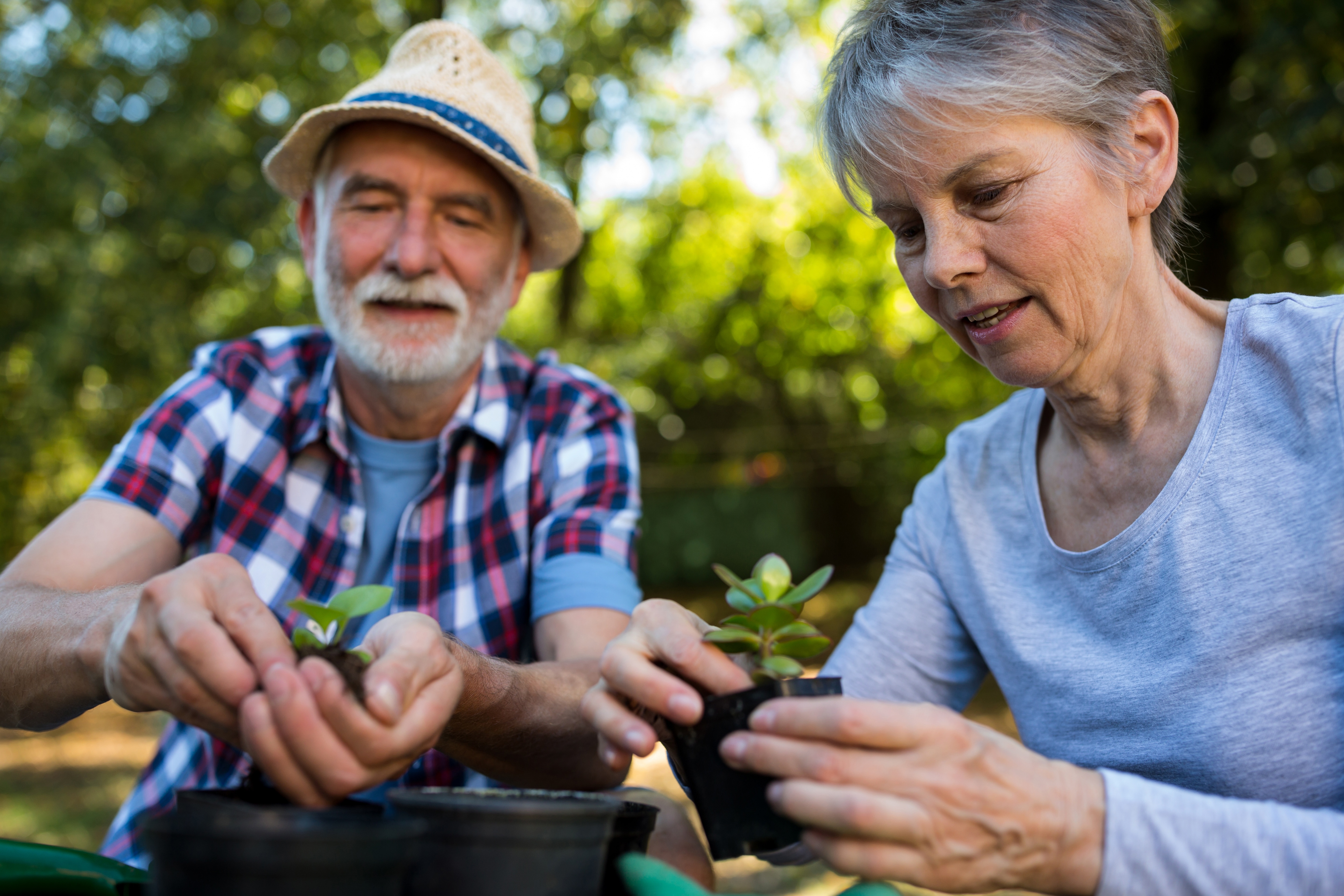
Senior couple gardening in the garden

Clipping vegetables and watering flowers can do wonders for the soul and have a profound effect on a stressed physiology. Horticultural therapy is a health-care specialty that uses gardening to promote physical and emotional health by creating a peaceful oasis amid the challenges of Alzheimer’s disease, or any other caregiving situation.

Therapy gardens encourage memory-impaired people and their caregivers to take a moment to smell the roses and perform tasks that magically momentarily take away their cares and worries. You might already being working in the garden, which is a natural balm for these anxiety-filled days.

If you are caregiving for a loved one at home, gardening is a great opportunity for you and your care partner to spend time outdoors, connect through memories that might arise, and de-stress. You’ll also gain the satisfaction of accomplishing something that will, hopefully, provide you with beauty, sweet scents, and/or food!

Here are some ways to include your care partner so that you both benefit—from the “Horticulture Therapy by horticulurual therapist Pam Catlin, chapter 17 in my book “Calmer Waters: The Caregiver’s Journey Through Alzheimer’s and Dementia.


Throughout the ages people have connected over food and the garden setting provides an abundance of taste experiences through edible flowers, herbs, and vegetables.  Not all non-poisonous flowers are tasty or have a pleasing texture, however.  Some tried and true edible flowers are nasturtiums, lavender, day lilies, roses, tulips, pansies and violas.  The flowers can be used in salads, baking, decorating cakes and so much more. In caring for these flowers, chemical pesticides must be avoided.

Herbs and vegetables are a great addition to a garden and they provide another taste experience for the gardener.  Examples of easy to grow herbs are basil, chives, mint, oregano, parsley and rosemary.  Some are even perennials that will come back each year. These herbs might be enjoyed by being mixed into plain yogurt or softened cream cheese to create an easy dip to spread on a cracker.  When selecting vegetables, keep in mind that all of the solanaceous family (tomatoes and eggplant) have toxic foliage.  With close supervision, they can still be planted as most gardeners love a beautiful ripe tomato.

For those who have retained their olfactory senses, just running hands over herb plants provides a fragrance to inhale and enjoy.  Scented geraniums, grown for their foliage and not their bloom, date back to Victorian times and are now available in most nurseries in a variety of fragrances including but not limited to citrus, chocolate and rose. Particularly fragrant flowers to include in your garden are sweet alyssum, heliotrope, pansies and cosmos.

When selecting plants to stimulate the visual senses, it is important to remember that bright colors such as reds, pinks and yellows are more easily seen by older eyes than subtle, pastel colors or white.   Don’t forget interesting leaf patterns when looking for visual stimuli.  Unusual leaf patterns and colors can be found in coleus, Rex begonias and some grasses, such as zebra grass.

Consider adding some auditory elements to the garden.  Wind chimes near the patio door can assist in orienting an individual to the door’s location.  Grasses, trees, plants with seed pods, water features and bird feeders can all add a variety of pleasant sounds to the garden.

As the other senses fade, tactile stimulation becomes an important part of the gardening experience.  Selections that are surprisingly soft to the touch are dusty miller, African fountain grass and lamb’s ears.  Smooth skinned succulents provide tactile interest and can be grown indoors and (weather permitting) outdoors.  Placing plants with texture near the edges of containers or beds is an invitation to garden visitors to touch and feel as they move through the outdoor space.  If the gardener with cognitive issues is not responsive to the stimuli when touching with their fingers try running a fuzzy leaf across the cheek.  The apple of the cheek is filled with tiny nerve endings that will often be more receptive than the nerve endings in older fingers.

What you need to set up a therapy garden in your yard or porch

As the person with memory loss advances in his or her disease process, physical balance tends to become a challenge. an effective way to create a safe gardening experience is to elevate the growing areas either through raised beds or large ports. For those able to stand for short periods of time, a variety of planter heights would be ideal to support gardening while standing or sitting. rEcommended dimensions for planter height is 2′ – 2 1/2′ for sitting or 3′ – 3 1/2′ for standing. Acceptable dimensions for widths are 2′ if accessible from only one side or 4/ if accessible from all sides.

If the gardener has limited reach, avoid building materials such as bricks or block as it would be difficult to reach the soil to plant. It’s a good idea to measure what would be comfortable for the user before constructing the garden. Growing in pots or raised beds requires good planting mixes (combination of peat moss, topsoil and sand or perlite or a good quality soilless mix), regular fertilizing and plants that are no taller than 3′.

These days, many large pots are lightweight and easy to move andn place prior to filling with soil mix. Pots can be placed on rolling saucers, provided the wheels have brakes, or on pavers to help raise

Successful Plants

There are a number of tried and true plants that are safe for the garden.  For cool weather gardening, calendulas, pansies/violas, and stock add bright color.  Cool season vegetables are broccoli, cabbage, cauliflower, kale, lettuce, peas, radishes and spinach. Suggested plants for the warm season shade garden are coleus, impatiens, begonias and mint.  Good plants for warm season sunny locations would be alyssum, dusty miller, geraniums, marigolds, purple cup flower, petunias, portulaca, snapdragons, zinnias, most herbs other than mint and most vegetables other than those mentioned for cool season planting.   Bush varieties of squashes and cucumbers are best suited for raised beds and pots, as are some varieties of tomatoes.

A piece of advice when creating a garden space is to start small.  The primary purpose of this growing area is to provide peace of mind and an avenue of connection for the person with memory loss and those providing care, not food production.  A garden that provides a balance of physical activity and just being in nature is a perfect addition.


image

Barbra Cohn cared for her husband Morris for 10 years. He passed away from younger-onset Alzheimer’s disease in 2010. Afterward, she was compelled to write “Calmer Waters: The Caregiver’s Journey Through Alzheimer’s & Dementia”—Winner of the 2018 Book Excellence Award in Self-Help—in order to help other caregivers feel healthier and happier, have more energy, sleep better, feel more confident, deal with feelings of guilt and grief, and to ultimately experience inner peace. “Calmer Waters” is available at AmazonBarnes & NobleBoulder Book StoreTattered Cover Book Store,  Indie Bound.org, and many other fine independent bookstores, as well as public libraries.

10 New Year Resolutions for Caregivers

2020 New year concept. Goals list in stationery, blank clipboard, smartphone, pot plant on pink pastel color with copy spaceYou’re tired, you’re stressed–You and 45 million or so American caregivers. So what are you going to do about it? Don’t say that “I don’t have time to take care of myself.” I’ve been there and done that. But I always promised myself that I was not going to be a martyr and sacrifice my health for my husband’s illness. Because if both of us went done that wasn’t going to serve any purpose, least of all our children. They were barely adults when my husband was in the throes of Alzheimer’s disease. They needed at least one healthy parent. And whether you are taking care of a spouse, parent or child, there are other people in your life who love and need you, not necessarily to take care of them, but to love and support them emotionally.

When you are a caregiver, it’s hard to find the time to go to the gym or even take a shower, somedays. But it’s absolutely vital that you take care of yourself or you will end up getting sick and then who will take care of your loved one? Who will take care of YOU?

Here are 10 easy ways to take the edge off your stress and fatigue so you feel some relief.

  1. Say a positive affirmation before you get out of bed. “This day is going to be a good one.” “I am grateful for my friends and family.” “I am healthy and full of energy.” “I am strong and competent.” Say something positive to set the tone of the day.
  2. Before you reach for a cup of coffee, drink a glass of hot water with lemon. It hydrates your body and brain, the lemon helps to alkalize the system (yes, it’s counter intuitive), which is usually too acidic, and it helps with regularity.
  3. Ask for help! You don’t have to do it all by yourself. No one is going to think badly of you if you take some time for yourself. If your loved one resents your going out, it’s okay. Don’t become a slave to their wishes and rants. If you can’t leave your loved one alone, please ask a neighbor, friend or home care professional to help at least a couple hours a week. Some social service programs provide free respite care.
  4. Many cities throughout the U.S. offer volunteer snowbusters (volunteers who will shovel your walk and driveway), fix-it volunteers who will help with easy home repairs, and yard maintenance volunteers.
  5. Meet a friend for a chat over coffee. Having a good chat and/or laugh, either via telephone or in person does wonders.
  6. Find a walking partner in your neighborhood and try to walk at least once a week (preferably 3 times a week).
  7. Put on a CD, vinyl record or the radio and listen to your favorite music. If your care partner is mobile, ask him/her to dance. There is nothing like music or dance to uplift the spirit.
  8. Use essential oils to immediately diffuse feelings of sadness, depression, anxiety, etc. Lavender oil is the most frequently used fragrance. You can also try bergamot, grapefruit, lemon, orange, clary sage, geranium, rose, and ylang ylang, frankincense, and myrrh. Put the oil in a diffuser or spray bottle to mist your collar or pillow. Find a fragrance that is pleasing to your care partner. It’ll help him/her also.
  9. Take a multi-vitamin mineral supplement to support your overall health, well-being, and immunity.
  10. It’s important to get at least 6 hours (preferably 7 or 8) of sleep every night. Of course, this isn’t always possible if you are caring for someone and need to get up at night, or are worried about paying the bills, taking care of the car, getting a new stove, etc. If you can’t get in the hours at night, put your feet up for 10 minutes during the day when your care partner naps. Or take a power nap. It really helps.

Wishing you and your loved ones a healthy, happy New Year! And remember that “this too shall pass.”

image

Barbra Cohn cared for her husband Morris for 10 years. He passed away from younger-onset Alzheimer’s disease in 2010. Afterward, she was compelled to write “Calmer Waters: The Caregiver’s Journey Through Alzheimer’s & Dementia”—Winner of the 2018 Book Excellence Award in Self-Help—in order to help other caregivers feel healthier and happier, have more energy, sleep better, feel more confident, deal with feelings of guilt and grief, and to ultimately experience inner peace. “Calmer Waters” is available at AmazonBarnes & NobleBoulder Book StoreTattered Cover Book Store,  Indie Bound.org, and many other fine independent bookstores, as well as public libraries.

30 Tips for Coping with Holiday Grief

candle lightThe holidays can bring up all sorts of emotions: joy, anxiety, depression and grief, especially if you’re missing a loved one, or if a loved one is a shadow of their former self.

You are entitled to feel any and all emotions as they arise. If you’re at a holiday party and the tears well up, simply excuse yourself until you’re ready to rejoin the group. If you’re overcome with fatigue and grief and simply can’t make it to a party, it’s okay. Make yourself a bowl of popcorn and watch a movie or read a book. But keep in mind that socializing might do you a world of good. The most important thing is that you do what’s best for YOU. So whatever you need to do in order to get through the holiday season, do it in a healthy way. Please don’t rely on alcohol or drugs to numb your feelings.

Here are some suggestions for feeling your emotions and feeling your best, while remembering your loved ones during the holidays and beyond.

  1. Be honest with yourself and with others. Tell them what you’d like to do and what you’d prefer not to do.
  2. Create a new tradition in honor of your loved one, i.e. if you typically hosted a dinner, set a place setting and serve your loved one’s favorite dish.
  3. Decide where you want to spend the holidays. Maybe go to a new place or take a trip with another widow or widower whom you met in a support group.
  4. If you’ve had a hard time discarding your loved one’s clothes, think about donating them to a homeless shelter, etc.
  5. Start journaling. It’s a wonderful way to express your feelings and get things off your chest.
  6. Write a letter to your loved one and express your love, your sadness, grief, guilt, etc.
  7. Place two chairs facing one another. Sit in one and speak out loud the words you would like to express to your loved one. Tell him or her how much you miss them, or express your anger and guilt, etc.
  8. Watch what you eat. You should definitely enjoy your favorite foods, but don’t use grief as an excuse to overindulge in foods that aren’t good for you.
  9. Splurge on a gift for yourself!
  10. Help out at a shelter or food bank, or make a donation in honor of your loved one.
  11. Don’t overcommit. You don’t need to make the holiday meal, if you’re not up to it.
  12. It’s okay to be happy. It’s the holidays! Don’t feel guilty for enjoying yourself. It won’t diminish the love you have in your heart for your loved one.
  13. Read a book that will help identify your feelings and cope more easily with grief. I recommend these two: The Empty Chair: Handling Grief on Holidays and Special Occasions by Ed.D Zonnebelt-Smeenge, Susan J. R.N. and Robert C. De Vries | Sep 1, 2001. The Secret Life of Grief: A Memoir by Tanja Pajevic, 2016, 2016
  14. Get a massage.
  15. Use aromatherapy. Citrus oils are generally refreshing and uplifting for the mind and emotions, relieve stress and anxiety.  Consider: bergamot, grapefruit, lemon, and orange. Floral oils are often used as a personal fragrance and are useful to relieve anxiety, depression, and irritability. These oils are useful as an inhaler, in a body lotion, and for the bath. Consider: clary sage, geranium, lavender, rose, and ylang ylang.
  16. Get the sleep that you need.
  17. Make an appointment with a professional therapist if you need help.
  18. Eat a serving of high-quality protein with every meal and snack
  19. Focus on complex carbohydrates (whole grains, veggies and fruits), and eliminate junk foods (refined carbs).
  20. Enjoy unlimited amounts of fresh veggies.
  21. Eat a good breakfast!
  22. Eat 3 balanced meals and 1-2 snacks/day.
  23. Magnesium, B complex, fish-oil, walnuts, flax seeds, dark leafy greens, and high quality all help reduce stress and uplift mood.
  24. Meditate, light a candle, or find some quiet time for yourself.
  25. Take a multi-vitamin mineral supplement to support your overall health, well-being, and immunity.
  26. Exercise! At least take a short walk every day.
  27. Put on a CD, vinyl record or the radio and listen to your favorite music. Dancing as though no one is watching. There is nothing like music or dance to uplift the spirit.
  28. Put on a funny YouTube video and laugh.
  29. Meet a friend for a chat over coffee. Having a good chat and/or laugh, either via telephone or in person does wonders.
  30. Do the best you can. Try to relax and enjoy your family and friends.

image-1

Barbra Cohn cared for her husband Morris for 10 years. He passed away from younger-onset Alzheimer’s disease in 2010. Afterward, she was compelled to write “Calmer Waters: The Caregiver’s Journey Through Alzheimer’s & Dementia”–winner of the 2018 Book Excellence Award in self-help– in order to help other caregivers feel healthier and happier, have more energy, sleep better, feel more confident, deal with feelings of guilt and grief, and to ultimately experience inner peace. “Calmer Waters” is available at AmazonBarnes & NobleBoulder Book StoreTattered Cover Book Store,  Indie Bound.org, and many other fine independent bookstores, as well as public libraries.

What if your dementia patient becomes abusive, aggressive or violent?

Angry, enraged senior woman yelling at a landline office phone, unhappy with customer service provided by the agent on the other side, giving off steam and smokeMy husband Morris was a gentle man. But occasionally, if things didn’t go his way, he would get nasty. Once Alzheimer’s took his brain hostage, he exhibited a darker side. But only when he was frustrated or confused.

Morris spent the last two years of his life in a memory care home. He was popular among the staff because he liked to goof around. When he walked the halls listening to music on his Walkman, he’d have a smile on his face and swagger to the rhythm. But if another resident got in his way, watch out. If it was crowded in the dining room and someone accidentally bumped him, he’d swing his arm out to shoo that person away. When one of his neighbors walked into Morris’s room mistaking it for his own, the two got into a rumble on the bed and fought like school boys. After this happened a couple more times, the neighbor was moved to the opposite side of the facility.

When Morris hit a resident in the dining room, the on-call physician prescribed a depressant to “calm him down.” Morris reacted to the drug by transforming into a zombie who slumped in his chair and slept too many hours during the day. I insisted that he get off the drug and Morris returned to his mostly cheerful self.

I once had a next door neighbor whose wife had Alzheimer’s. She threatened to kill her husband with a knife and then went on to slash a painting hanging in their living room. Was she or Morris responsible for their actions? No. A person with dementia is not responsible for acts of violence because as the disease progresses, neurons in the cortex that are responsible for language, reasoning and social behavior are destroyed. This leads to some Alzheimer’s patients engaging in aggressive or violent behavior such as biting, kicking, spitting, slapping, punching, and/or using foul language.

Research from the National Institutes of Health indicates that up to 96 percent of patients with dementia who were studied over a 10-year-period exhibited aggressive behavior at one time or other. In 2011, CNN Health reported that 5 to 10 percent of Alzheimer’s patients exhibit violent behavior at some point during the course of the disease.

There is usually a reason for aggressive behavior.

What to watch out for

  • Urinary tract infection
  • Pain or stress
  • Loneliness, depression
  • Too much noise or stimulation
  • Boredom
  • Constipation
  • Soiled diaper or underwear
  • Uncomfortable room temperature
  • Physical discomfort (stomach ache, etc)
  • Confusion
  • Anger about loss of freedom (to drive, living independently)
  • Drug reaction or contra-indication
  • Resistance against being told what to do such as bathing
  • Sudden change in routine, environment or caregiver
  • Communication problems
  • Hunger or not liking the food
  • Dehydration

What to do

  1. If your life or the life of the person you care for is in danger, get help immediately!
  2. The Alzheimer’s Association has a 24-hour helpline at 800-272-3900.
  3. Rule out UTIs, pain, discomfort, etc.
  4. Use an essential oil to help calm the person down. When my husband got agitated I’d put a few drops of oil on a cotton pad inside a diffuser and plug it into the wall. He usually calmed down immediately.  The following oils can be used in a diffuser, or put in a bath or fragrance free moisturizer. They can also be sprayed on a pillow or handkerchief. Citrus oils are generally refreshing and uplifting for the mind and emotions, relieve stress and anxiety, and are useful for odor management and appetite support. Consider: bergamot, grapefruit, lemon, and orange. Floral oils are often used as a personal fragrance and are useful to relieve anxiety, depression, and irritability. These oils are useful as an inhaler, in a body lotion, and for the bath. Consider: clary sage, geranium, lavender, rose, and ylang ylang. Tree oils are revitalizing with immune boosting properties, ease respiratory congestion, and are supportive to breathing ease. They are useful for pain relief, skin infections, and odor management, and can relieve nervous exhaustion and depression. Consider: eucalyptus (Eucalytpus citriodora or globulus), pine needle, sandalwood, or Tea Tree.
  5. Reassure your patient by speaking gently and calmly.
  6. Play calming music, i.e. Mozart
  7. Try to distract the person with a TV show, favorite snack (ice cream almost always works), or a walk outside.
  8. Maintain a regular routine.
  9. Make sure the lighting is suitable in the home or facility.
  10. Help the person to maintain as much dignity and independence as possible.
  11. Make sure the person is eating a nutritious low-sugar, low-salt diet, with no or very limited amounts of alcohol and caffeine.

image

Barbra Cohn cared for her husband Morris for 10 years. He passed away from younger-onset Alzheimer’s disease in 2010. Afterward, she was compelled to write “Calmer Waters: The Caregiver’s Journey Through Alzheimer’s & Dementia”–winner of the 2018 Book Excellence Award in self-help– in order to help other caregivers feel healthier and happier, have more energy, sleep better, feel more confident, deal with feelings of guilt and grief, and to ultimately experience inner peace. “Calmer Waters” is available at AmazonBarnes & NobleBoulder Book StoreTattered Cover Book Store,  Indie Bound.org, and many other fine independent bookstores, as well as public libraries.